.png)
What if the most powerful Sales tool in your B2B strategy is a well-run conversation around a table?
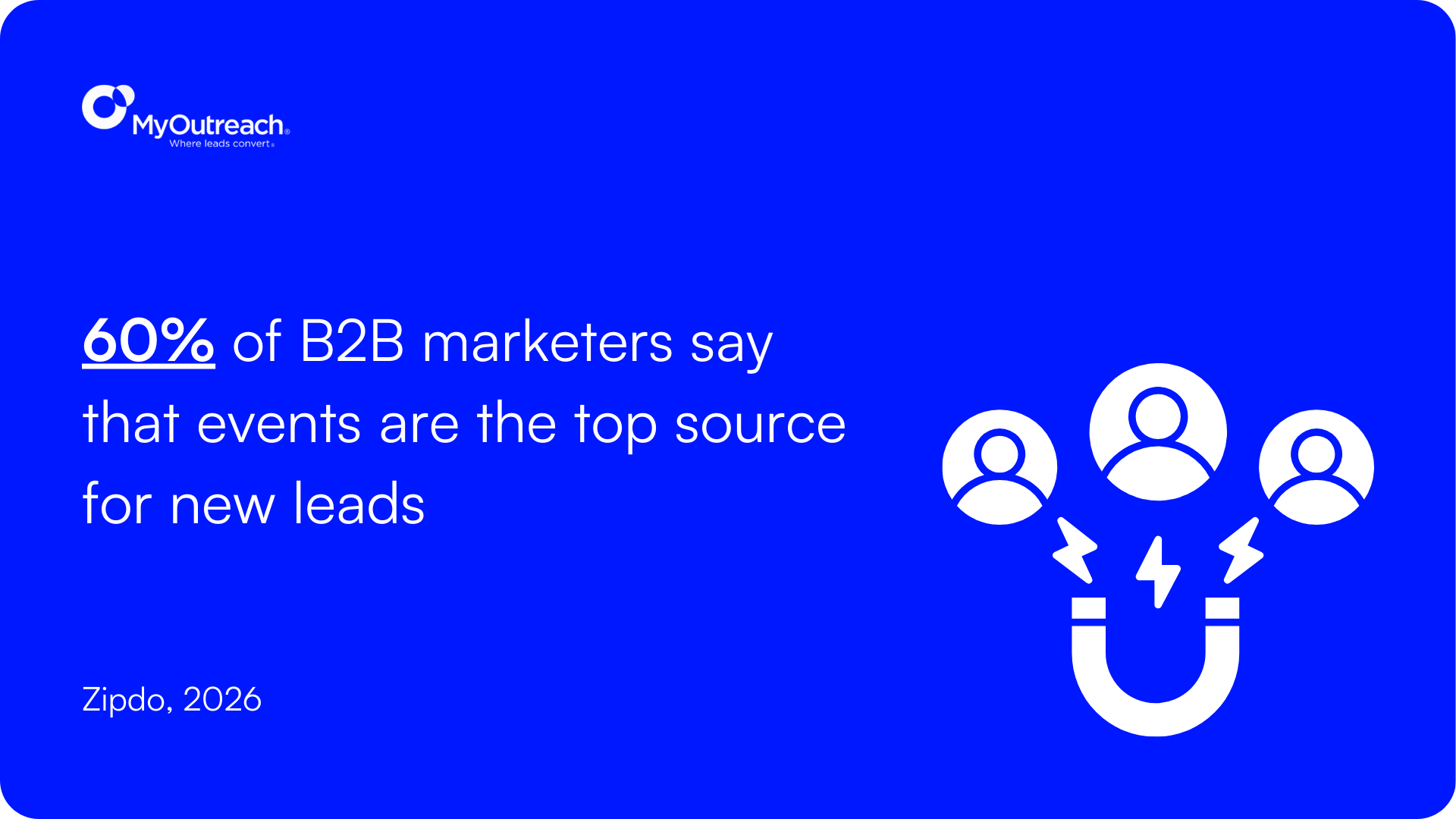
According to research, 60% of B2B marketers say that events are the top source for new leads. This comes from the increasing need to form in-person connections in a very digitalised world.
Having run countless successful executive events in the B2B SaaS industry, we've learned what separates a good roundtable event from a great one.
This 15-rule guide goes through the hard lessons we've learned. If you're looking to strengthen your event strategy or run your first ever event, this blog will help you curate the right room, nurture meaningful discussions and convert measurable business outcomes.
📖 You might also like: Executive Roundtables vs Webinars: A B2B Marketers Guide
Successful B2B Executive Events
Running a successful B2B executive event is all about relevance, preparation, and execution.
You need to carefully select senior decision makers that match your ICP and craft a discussion in which they'll find valuable insights. A great executive roundtable builds relationships, uncovers business opportunities and positions your brand as a trusted partner.
Now let’s breakdown the 15 rules that ensure your B2B executive events deliver impact and results.
Curating the Right Room for Successful Executive Events
The single biggest determinant of a roundtable's success is deciding who walks through that door and takes up space. Attendee curation is about engineering a room where conversations flow na3turally and value is created from every participant.
1. Rule 1: Lead with Peer Equivalence
The moment a VP of Engineering sits next to an SDR, the entire dynamic of the room shifts. Executive roundtables succeed because they create a safe space where leaders can speak candidly. Protect that environment by enforcing strict seniority criteria - C-suice, VP or Director-level minimum, of course, this depends on your market and target audience. Aim for 10 to 14 attendees. Fewer than 8 can make the discussion feel thin; while more than 14 can lose the intimacy of what makes an executive roundtable unique.
2. Rule 2: Balance Prospects & Customers at a 60/40 Ratio
A common mistake is filling the room entirely with prospects. This turns the event into a thinly veiled sales pitch. Instead invite existing happy customers at approximately a 40% ratio. They’ll become your credibility anchors - sharing real outcomes without prompting, handling objections you would never be allowed to raise and elevating the conversion from hypothetical to proven. One authentic customer story is worth more than any case study slide.
Rule 3: Screen Every Attendee with a Pre-Event Call
A 15-minute discovery call with each confirmed attendee before the event accomplishes 3 things:
- Validates their seniority and relevance.
- Surface their current priorities and pain points so you can design the agenda.
- Increases show rates dramatically.
In our experience, pre-screened attendees show up at a rate of over 85%, compared to roughly 60% for those who simply registered online.
4. Rule 4: Avoid Direct Competition in The Same Session
Nothing silences a room faster than two competing CMOs recognising each other across the table. Unless you are explicitly running a competitor-inclusive format (which has its own rules), keep direct competitors out of the same session.
You can always run multiple geographically or vertically segmented events. The conversation you protect is worth more than the additional seat.
📖 Useful read: Executive Roundtables to Drive Business Growth
Designing the Agenda for Successful Executive Events
Executive roundtables are not panel discussions, keynote presentations, or workshops. They occupy a distinct format that requires an agenda designed around conversation, not content delivery. The following rules will help you build a structure that generates insight rather than broadcasts it.
5. Rule 5: Open with Proactive Questions
Attendees can lose focus fast. Start your roundtable with a single, well-framed opening question that invites immediate participation - something like: 'What is the one thing your board is asking about AI that you do not yet have a confident answer to?' This signals immediately that this is their room, not yours.
6. Rule 6: Structure The Event in Three Acts
The most effective roundtables follow a three-act structure.
- Act one (20 to 30 minutes) is context-setting - establishing the shared challenges and letting attendees hear themselves reflected in their peers' challenges.
- Act two (45 to 60 minutes) is the core debate - the structured exploration of the topic where real insights emerge.
- Act three (20 to 30 minutes) is forward focus- what will each attendee actually do differently on Monday morning?
This arc creates a satisfying narrative and makes the event feel purposeful.
7. Rule 7: Build in White Space
Over-programming is one of the most common agenda mistakes. Leave at least 20% of your scheduled time as unstructured white space - the breaks, the hallway conversations, the lingering after the formal session ends. Some of the highest-value exchanges happen when the agenda is not running. A roundtable that respects executives' intelligence also respects their ability to create their own value when given the space to do so.
Facilitation Mastery for Successful Executive Events
Facilitation is a craft that is almost universally underestimated by B2B event organisers. Most companies assign someone from marketing or sales to moderate the discussion. The results are predictable - the conversation either stalls or spirals into unproductive bits. These four rules will help you facilitate like a professional.
8. Rule 8: Master the Art of the Redirect
Every roundtable has at least one participant who talks too much and at least one who says nothing. A skilled facilitator redistributes airtime without embarrassing anyone.
Develop a set of neutral redirect phrases such as: 'That is a really interesting angle - I want to make sure we also hear from those of you dealing with this from a different point' or 'Let me pause here and check in - does anyone see this differently?' These phrases are conversational moves that shift momentum without creating awkward silences.
9. Rule 9: Never Answer Your Own Questions
The facilitator's job is to ask and listen, not to demonstrate their own expertise. If you answer your own question - even to fill a silence- you signal that this is a lecture, not a discussion. Comfortable silence is one of the most powerful facilitation tools available. Allow three to five seconds after asking a question before intervening. What feels uncomfortably long to you often produces the most candid responses from participants.
10. Rule 10: Assign a Dedicated Scribe
Your facilitator can’t simultaneously manage group dynamics and capture key insights emerging from the discussion. Always assign a separate note-taker whose sole job is to document themes, direct quotes (with permission), and actionable insights in real time. These notes become the raw material for your post-event content, personalised follow-up, and internal deal notes. Some organisations use a live digital display to show themes being captured - this increases attendee engagement and makes participants feel genuinely heard.
11. Rule 11: Surface Tension Carefully
The most memorable roundtable moments often come from productive disagreement. When two attendees hold conflicting views, resist the instinct to resolve the tension immediately. Instead, name it explicitly: 'I am noticing two quite different perspectives here - one that says X and one that says Y. I think this tension is actually at the heart of what many of you are navigating. Who else has a stake in how this resolves?'
Handled well, productive tension creates the kind of intellectual energy that attendees talk about for months.
Logistics & Experience Design
The environment in which a roundtable takes place communicates as much as the agenda itself. Executive attendees make rapid judgments about the care and intentionality behind an event based on the physical and logistical details they encounter.
12. Rule 12: Sweat the Small Stuff Intentionally
Venue selection should prioritise acoustic comfort, appropriate table geometry (round or oval tables of the right pick), natural light, and freedom from interruption. Name placards should be pre-positioned based on a strategic seating plan (not alphabetical or random).
Attendees should be distributed around the table, not clustered together. A pre-event brief for all staff, including servers and AV technicians, should make clear that the conversational environment is the product and has to be protected at all costs.
Follow-Up Strategies That Convert
The roundtable is not the end of the programme, it’s the beginning of a more informed, more personal sales and relationship motion.
Most B2B organisations send a generic thank-you email within a week and wonder why their pipeline numbers do not move. These final 3 rules will fundamentally change how you think about follow-up.
13. Rule 13: Send a Personalised Insight Summary Within 48 Hours
Speed and specificity are the two variables that determine whether your follow-up cuts through. Within 48 hours of the event, all attendees should receive a personalised communication that references a specific comment they made, connects it to a broader theme from the discussion, and offers a relevant next step. This is not a mass mail-merge — it requires the notes from Rule 10 and a writer who can craft a paragraph that makes the recipient feel genuinely seen. In our experience, this approach generates a follow-up meeting conversion rate that is three times higher than generic post-event outreach.
14. Rule 14: Create a Post-Event Content Asset
The collective intelligence generated at a well-run roundtable is genuinely valuable. Distil the key themes into a short, anonymised insight report - typically four to six pages - that captures the consensus views, the points of constructive disagreement, and the forward-looking priorities that emerged.
This document serves multiple purposes: it gives attendees something to share internally that keeps you on top of their mind, it provides a content asset for your marketing team, and it creates a natural reason to re-engage non-attendees who expressed interest in the event. A well-designed insight report can generate pipeline for months after the original event.
15. Rule 15: Build a Peer Community
The highest-performing executive roundtable programmes we have observed treat each event as a chapter in an ongoing peer community, not a standalone sales tactic. After two or three events, you will have assembled a group of senior leaders who share challenges, trust your facilitation, and associate your brand with peer value. Invest in that community - through a private LinkedIn or Slack group, a quarterly digest of curated insights, or annual flagship gatherings.
Conclusion
The most effective executive roundtables don’t treat events as one-off campaigns. They treat conversation as the product, attendees as co-creators, and follow-up as the starting point.
Organisations that invest in well-structured executive roundtable events consistently outperform traditional demand generation tactics - with shorter sales cycles, higher-value deals, and stronger long-term relationships that no digital channel can replicate.
The real question isn't if executive roundtables work. It's if yours are working as hard as they could.
If you’re ready to build or refine a strategy that drives measurable business outcomes, explore how we deliver successful B2B executive events at MyOutreach.


.webp)

.webp)
.webp)