
.png)
Executive roundtables are gaining popularity as a practical way for companies to drive business growth by bringing together small groups of senior leaders to exchange real-world-insights.
Yet many executives lack access to trusted peer input. Nearly 66% of CEOs report not receiving coaching or outside advice, limiting fresh perspectives on strategic business decisions and innovation.
Without outside viewpoints, decision-making slows, blind spots are wider and innovation suffers.
In this blog post, we'll explore why executive roundtables are one of the most effective tools for business growth and innovation. You'll learn how they strengthen decision-making and strategic thinking, and how they spark new ideas through peer collaboration.
How Executive Roundtables Drive Business Growth
Executive roundtables for business growth are built to turn peer insights into real results. By operating in peer-only environments, roundtables allow executives to work through business challenges with leaders facing similar pressures.
This structure leads to clearer strategic direction and faster decision-making, helping organisations reduce risk, prioritise the right initiatives and drive sustainable business growth.
What Defines Executive Roundtables
An executive roundtable is built on a few core principles:
- Small, curated groups
Executive roundtables typically include 12 to 16 senior leaders from non-competing organisations, ensuring diversity of perspective without conflict of interest.
- Peer-level participation
Members hold comparable roles or levels of responsibility, such as CEOs, CMOs, or CROs. This creates relevance, trust and honest discussions.
- Regular cadence
Unlike one-offs, executive roundtables meet monthly or quarterly, allowing relationships and learning to deepen over time.
- Facilitated discussion
Sessions are led by an experienced moderator who keeps conversations focused, balanced and outcome-driven.
- Real business challenges
Topics centre on live strategic issues and not on theory or generic threads.
- Mutual value exchange
Every participant contributes insights and receives them in return, creating a culture of mutual support and accountability.
Core Elements of Effective Roundtables
These are the key elements that make executive roundtables high-performing:
- Confidentiality agreements: Clear confidentiality agreements create a safe space where participants can speak openly about failures, uncertainty and major decisions without worrying about competitive risk. This trust is what enables honest, valuable conversations.
- Structured facilitation: A skilled moderator ensures everyone contributes, stops one person from dominating, and keeps the group focused on practical outcomes.
- Accountability mechanisms: Strong roundtables don't stop at discussions. Members commit to next steps and report back on progress.
How Executive Roundtables Deliver Strategic Decision-Making
The isolation of leadership presents a persistent challenge: as executives climb organisational ladders, the number of peers they can turn to for unbiased advice diminishes dramatically. Executive roundtables expand leaders' advisory networks quickly.
Consider the typical strategic decision process. A CEO might consult their board, senior team, and an external advisor. While valuable, these perspectives often come with inherent biases - board members have concerns, team members have positional interests, and paid consultants might have incentive conflicts.
Roundtable peers offer something different: Experienced judgment without an agenda. When a retail executive shares a digital transformation challenge, they might receive insights from a manufacturing leader who navigated similar technology challenges.
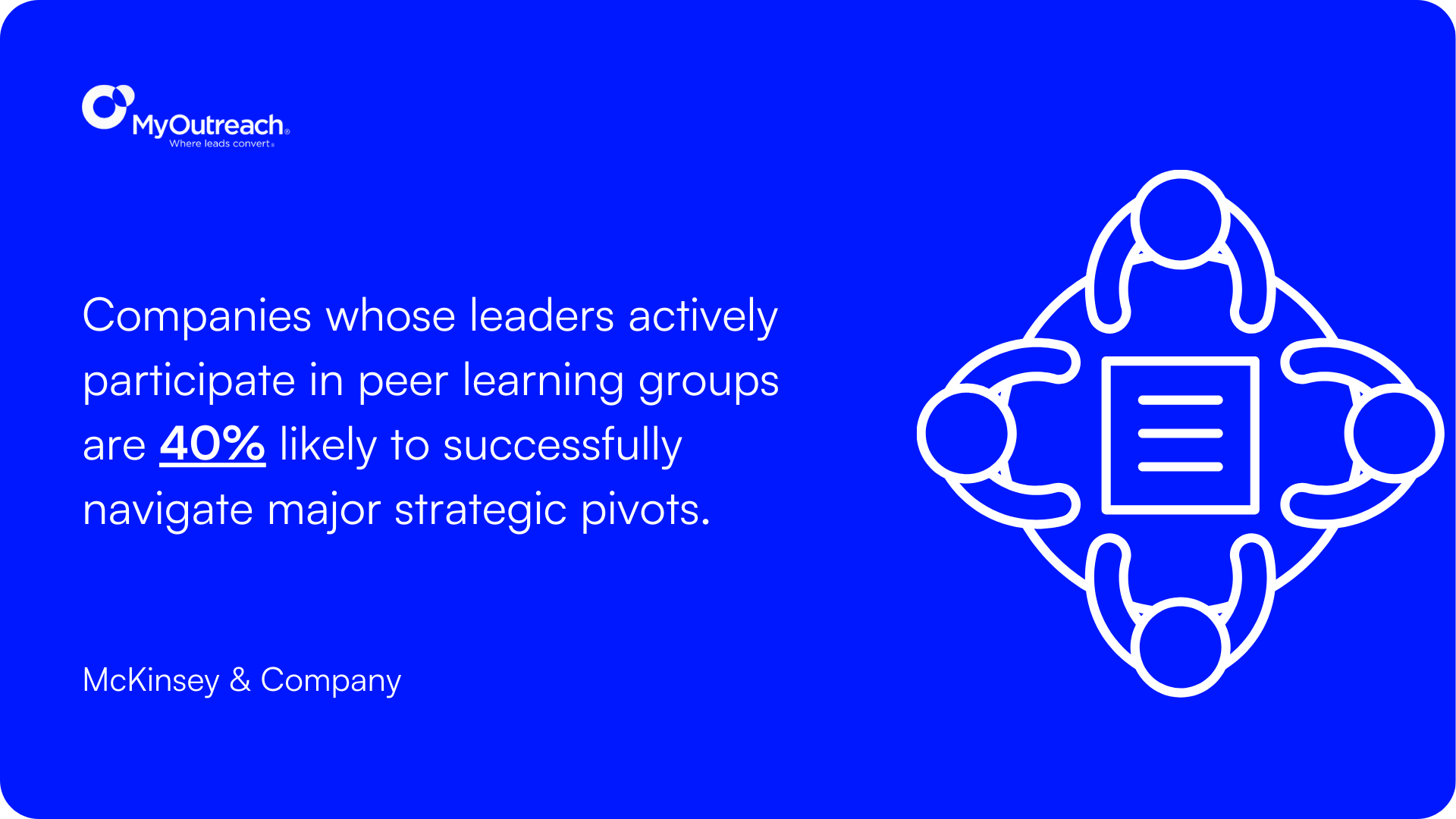
This cross-industry wisdom proves practically valuable during infection points. Research from McKinsey indicates that companies whose leaders actively participate in peer learning groups are 40% likely to successfully navigate major strategic pivots compared to those that don't leverage external perspectives.
Innovation Through Diverse Perspectives
Innovation rarely comes from homogeneous thinking. Executive roundtables function as innovation accelerators because they bring together leaders from different industries, organisational cultures and business models.
Effective roundtables also incorporate executives at different organisational life stages and from various functional backgrounds.
Studies show that exposure to contrasting perspectives rewires our brains, making us more adaptable and creative problem-solvers. For executives, this translates directly into a competitive advantage.
Innovation Case Studies
Innovation rarely comes from staying inside your own industry bubble.
Research supports this:
- Leaders with diverse peer networks are more likely to develop and implement successful innovations.
- Companies that invest in better user experience grow revenue significantly faster than competitors and reduce service costs.
- Executives who participate in structured peer groups make better strategic decisions and adopt new ideas more quickly.
Building Strategic Relationships After Executive Roundtables
The relationships made in executive roundtables create compounding value over time. Unlike transactional networking, where connections fade after initial introductions, roundtable bonds deepen through repeated, substantive interactions.
Trust develops gradually as members witness each other's vulnerability, integrity, and follow-through. When an executive shares a significant challenge in one session and reports back on progress in the next, their credibility grows. Over months and years, these relationships evolve into trusted advisory networks that executives can activate whenever they face critical decisions.
The strategic partnership opportunities alone justify roundtable participation for many leaders. Non-competing members can explore collaborations that benefit both organisations - whether through technology sharing, joint ventures, or mutual customer introductions.
Beyond formal partnerships, the relationship capital proves invaluable during career transitions. Roundtable members frequently become references, board candidates, or advisory board members for each other's companies. Some executives report that roundtable connections have been instrumental in securing their next leadership role or successfully navigating merger negotiations.
The Mentorship Multiplier
Roundtables naturally facilitate both formal and informal mentorship. More experienced executives provide guidance to those newer to the C-suite, while emerging leaders often introduce fresh perspectives and technological savvy that benefit seasoned veterans.
This bi-directional learning pushes professional development. Rather than seeking a single mentor, roundtable participants gain access to multiple trusted advisors with diverse expertise. When facing a complex challenge, they can consult the group member most qualified to provide guidance on that specific issue.
The mentorship extends to organisational levels as well. Executives often invite roundtable peers to speak at company leadership off-sites, conduct workshops for their teams, or provide outside perspective during strategic planning sessions.
📖 You might also like: How to Master Executive Event Planning: A B2B Marketer’s Guide
Measurable Impact on Business Performance & Leadership Effectiveness
While the qualitative benefits of executive roundtables are compelling, data-driven leaders rightfully ask about quantifiable return on investment. Fortunately, multiple studies demonstrate clear performance advantages for roundtable participants.
Research conducted by Vistage International found that member companies grow significantly faster than average small-to-medium enterprises. During economic downturns, members were far more likely to grow their businesses compared to non-members.
Leadership development impact is equally strong. Longitudinal research tracking executives in peer learning groups shows measurable improvements in emotional intelligence, strategic thinking, and change management effectiveness.
Employee engagement scores also trend higher in organisations led by roundtable participants, as leadership insights cascade into culture and communication improvements.
Quantifying Specific Outcomes
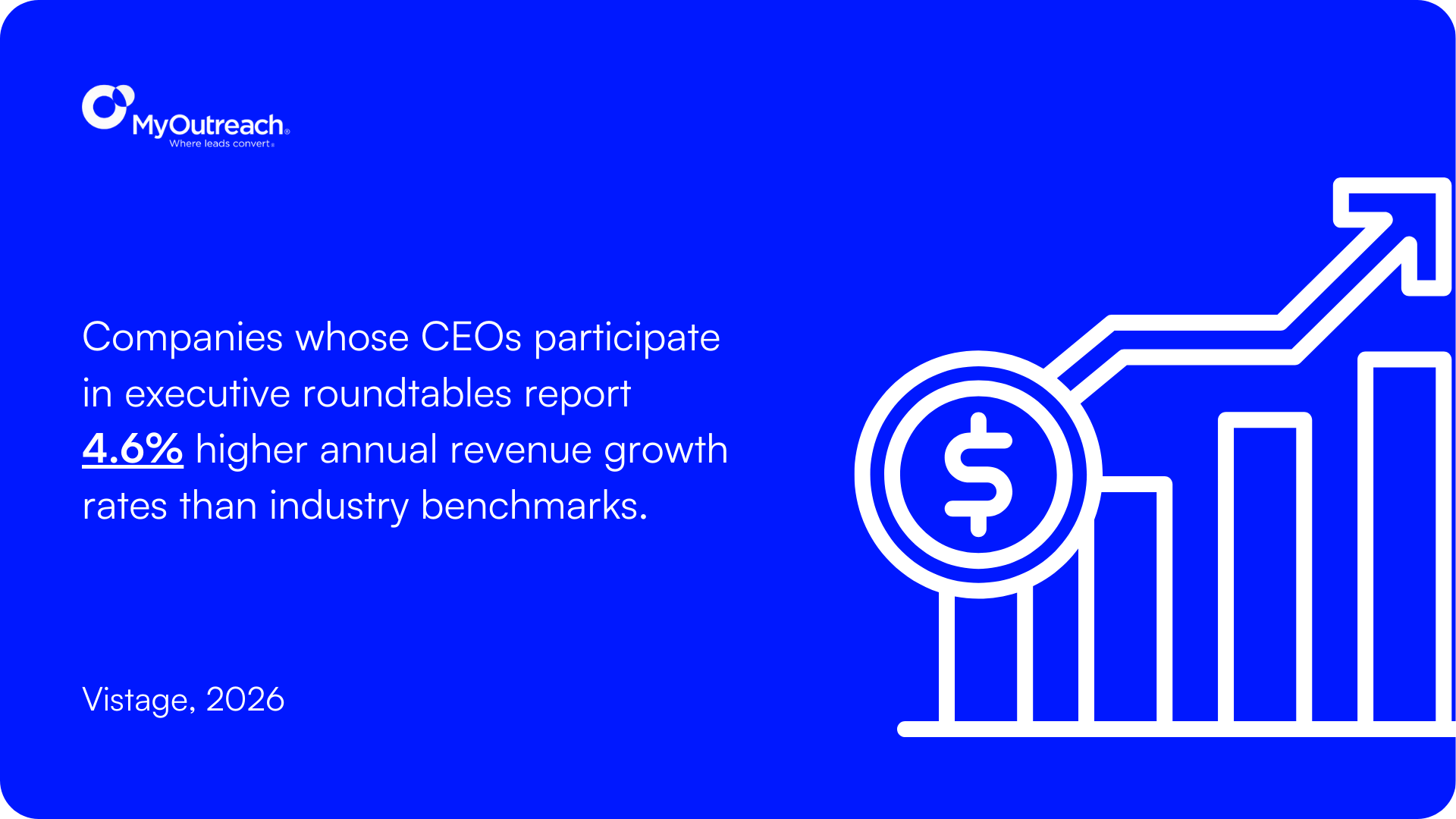
Revenue growth: Companies whose CEOs participate in executive roundtables report 4.6% higher annual revenue growth rates than industry benchmarks.
Decision speed: Leaders with roundtable access make critical strategic decisions faster on average.
Risk mitigation: Roundtable participants report fewer costly strategic mistakes.
Innovation output: Organisations led by roundtable members launch new products or services at higher rates.
Best Practices for Executive Roundtable Participation
Active engagement separates transformational experiences from disappointing ones.
Executives who deliver maximum value come prepared, share genuine struggles, and request specific help.
Successful participants document insights quickly and create action plans. They report progress back to the group, creating accountability loops.
Contribution = Return
Executive roundtables operate on reciprocity. Leaders who generously share expertise and resources receive disproportionate value in return.
Creating a High-Impact Executive Roundtable
Creating a successful executive roundtable requires more than gathering leaders. Strategic design determines impact.
Essential Implementation Steps
- Secure expert facilitation from day one, professional moderators manage group dynamics and maintain focus.
- Design your agenda thoughtfully, and balance structured topics with organic conversation.
- Establish confidentiality protocols immediately; psychological safety enables vulnerability and insight.
- Implement follow-through systems; value often emerges in follow-up.
Innovation Catalysts: How Roundtables Generate Breakthrough Thinking
Cross-pollination creates unexpected connections - confidential environments transform innovation potential.
Four Innovation Mechanisms in Action
Trend translation across sectors, safe-fail experimentation, permission to think ambitiously, and resource sharing generate breakthroughs.
Measuring Success: ROI Metrics That Matter
Track business performance, leadership effectiveness, implementation rates, and network activation.
Navigating Common Obstacles & Maximising Long-Term Value
Calendar conflicts, engagement fluctuations, and group dynamics require proactive management.
The Future of Executive Peer Learning
Executive roundtables continue evolving to meet changing leadership needs and leverage technological capabilities. Understanding emerging trends helps both establish new groups and revitalise existing ones.
Technology now allows executives in different regions to participate regularly, diversifying perspectives. The most effective models blend quarterly in-person intensives with monthly virtual sessions, capturing the benefits of both formats.
Specialised focus areas are proliferating as executives seek increasingly targeted peer learning. Niche forums now address specific challenges: diversity and inclusion transformation, digital business model innovation, sustainable business practices, or navigating activist investors.
📖 Useful read: Roundtable Events: A Guide for B2B Marketers
Challenges of Executive Roundtables (& How to Overcome Them)
Even well-designed executive roundtables face practical challenges. Their long-term success depends on recognising these risks early and managing them deliberately.
Time constraints
Senior leaders operate under intense time pressure. Without tight agendas and clear outcomes, roundtables risk being deprioritised. High-performing groups address this by:
- Scheduling sessions well in advance.
- Keeping meetings outcome-focused.
- Treating participation as strategic time, not optional networking.
Uneven participation
Some executives naturally dominate discussions while others hold back. This reduces the collective intelligence of the group. Skilled facilitation is critical to:
- Balance airtime.
- Draw out quieter voices.
- Prevent discussions from becoming one-sided.
Loss of focus over time
If topics become repetitive or too abstract, engagement drops. Roundtables maintain relevance by:
- Rotating discussion themes.
- Using real business cases.
- Refreshing formats periodically.
- Aligning issues with current market pressures.
Confidentiality concerns
Trust can fall quickly if sensitive information is mishandled. Successful roundtables:
- Set clear confidentiality rules from day one.
- Reinforce expectations regularly.
- Use professional facilitation to protect psychological safety.
When these challenges are managed proactively, executive roundtables remain valuable rather than becoming routine meetings.
Conclusion
Executive roundtables work because they solve a fundamental leadership problem: isolation.
They replace:
- Solo decision-making with shared judgement.
- Internal bias with external perspective.
- Theories with real-world experience.
They help leaders:
- Make better strategic decisions.
- Innovate faster.
- Build stronger professional networks.
- Develop their leadership styles.
As business complexity increases and certainty decreases, the ability to think alongside trusted peers becomes a strategic advantage rather than a luxury.
An executive roundtable is not just a forum for discussion. It is a decision-support system, an innovation engine, and a leadership development platform combined.
For organisations seeking smarter growth and better leadership, executive roundtables are among the most practical and proven tools available.
How MyOutreach Drives Business Growth With Executive Roundtables
At MyOutreach, we help organisations design and run high-impact executive roundtables to drive business growth and measurable outcomes.
If you’re looking to launch or scale an executive roundtable that strengthens decision-making, accelerates innovation, and builds long-term leadership value. Let’s talk!
FAQs
Q1. What is an executive roundtable?
An executive roundtable is a small, structured peer group in which senior leaders meet regularly to discuss strategic challenges, share experiences, and learn from one another in a confidential setting.
Q2. Who should join an executive roundtable?
Executive roundtables are designed for senior decision-makers such as CEOs, CMOs, CROs, and founders. They are most valuable for leaders who want an external perspective on strategy, growth, and leadership decisions.
Q3. How many people should be in an executive roundtable?
Most effective roundtables include between 8 and 16 participants. This keeps discussions diverse while allowing everyone to contribute meaningfully.
Q4. How often should executive roundtables meet?
High-performing roundtables typically meet monthly or quarterly. Regular cadence helps build trust, accountability, and long-term learning.
Q5. Are executive roundtables industry-specific?
They can be, but many of the most innovative roundtables are cross-industry.
Networking events focus on making connections. Executive roundtables focus on solving real business problems through structured, facilitated discussion and long-term peer relationships.


.webp)

.webp)
.webp)