
Looking for content syndication ideas that do more than fill a distribution calendar? This is a practical breakdown of the seven content types that consistently generate qualified leads when syndicated, with examples of when each one works, how to match it to the buyer's journey, and the mistakes that quietly waste budget.
Before the list, two quick framing sections worth reading, then the seven ideas in full.
What content syndication actually is (and what it is not)
Content syndication is the practice of distributing your content through third-party channels, publisher networks, industry sites, email newsletters, and partner platforms, to reach buyers beyond your owned audience. Done well, a single asset stops being a one-time download on your website and becomes a repeatable lead generation engine running across dozens of touchpoints.
The distinction that matters: content syndication is not lead buying. Buying a list gets you names. Syndicating the right asset to the right audience gets you people who raised their hand by engaging with something useful. The difference shows up later, in whether your sales team accepts the leads or rejects them.
That is also why the choice of content matters more than most teams think. A misdfit asset produces form fills that look like leads and behave like noise. The seven ideas below are the formats that reliably produce the second kind.

How to choose the right content syndication idea
There is no single best content type. The right one depends on where the buyer is in their journey, and matching the two is one of the most common places syndication campaigns fall over.
Early-stage buyers, the ones still defining their problem, want education. Trend reports, explainer ebooks, and infographics fit here, because they ask very little of the reader and deliver fast value. Push a pricing guide or a demo at this stage and they scroll past.
Mid-stage buyers, actively comparing options, want frameworks and proof. Whitepapers, on-demand webinars, and benchmark content earn their attention because these buyers are weighing approaches and want substance.
Late-stage buyers, close to a decision, want validation. Case studies, user-generated content, and ROI-focused material help them justify the choice internally and de-risk the purchase.
Hold that mapping in mind as you read the seven ideas. The format is only half the decision; the stage it is aimed at is the other half.
Why content is the key in content syndication?
Nowadays staying ahead of the curve is more crucial than ever for brands seeking to maintain relevance and drive impactful marketing campaigns. As the digital ecosystem continues to evolve, so do the strategies and tactics used in content syndication marketing. Understanding the latest and emerging technologies is not just beneficial but essential for brands looking to remain competitive, adapt to changing consumer behaviours, and maximize the impact of their syndicated content.
Consider these statistics:
- According to a survey by Demand Metric, 80% of B2B marketers are using content syndication as a part of their content marketing strategy, highlighting its widespread adoption and effectiveness in reaching target audiences.
- The Content Marketing Institute reports that 78% of B2B content marketers use email newsletters for content syndication, making it one of the most popular distribution channels. This underscores the importance of leveraging email as a strategic tool for disseminating syndicated content and nurturing leads.
- Research by Curata found that 74% of companies indicate that content marketing has increased their lead quality and quantity, indicating the significant impact of content syndication on lead generation efforts.
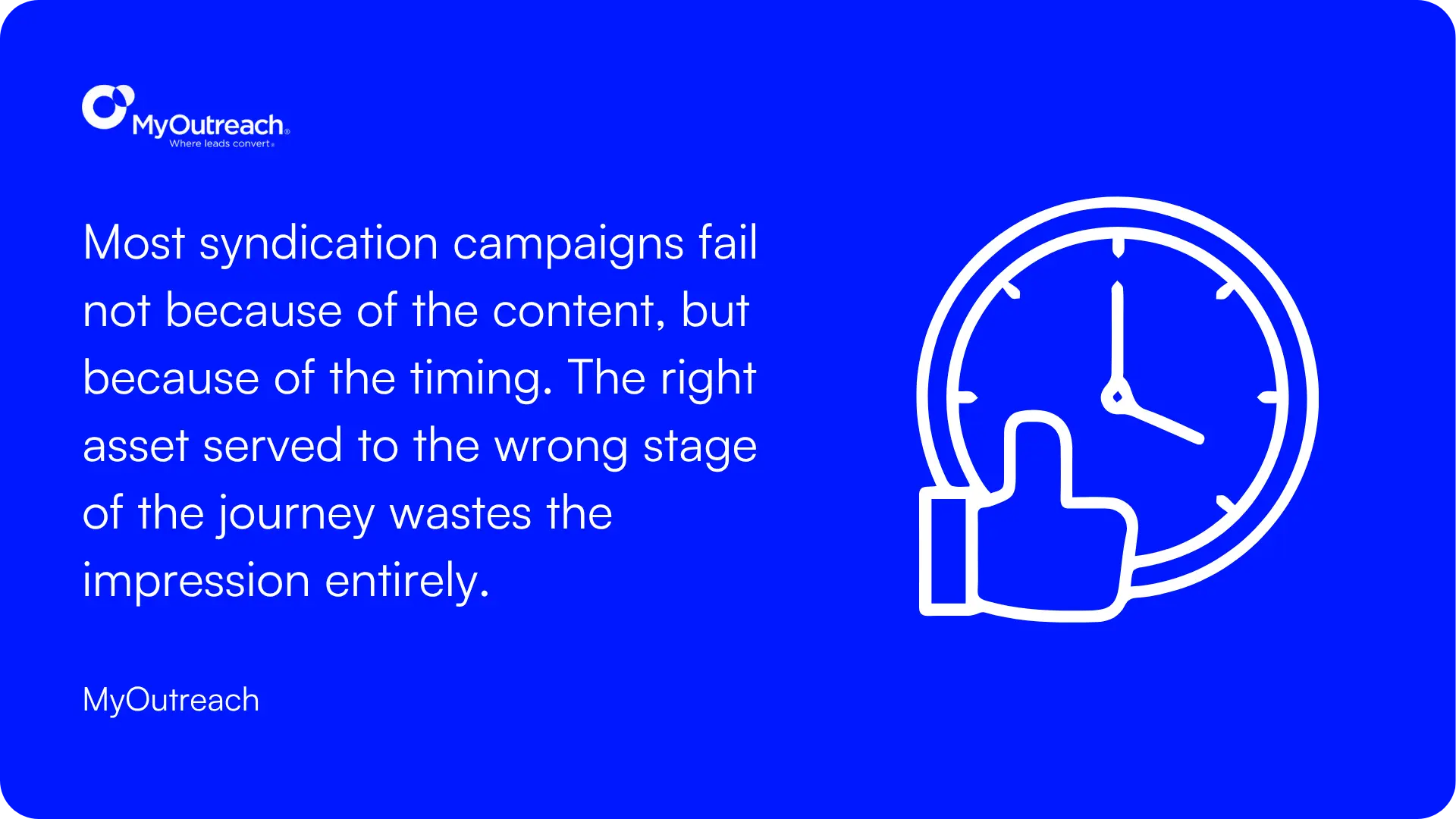
- A study by Aberdeen Group revealed that companies with strong content syndication strategies achieve 27.1% greater annual revenue growth compared to those without such strategies, demonstrating the tangible benefits of investing in content syndication initiatives.
- The adoption of AI-driven content syndication tools is on the rise, with a projected market value of $3.74 billion by 2027, according to Grand View Research. This highlights the growing importance of leveraging artificial intelligence and automation technologies to optimize content syndication processes and enhance marketing outcomes.
7 highly efficient content ideas for your next content syndication campaign
Utilize these seven types of content to ensure that your content syndication endeavours yield valuable outcomes, boosting revenue and advancing your business growth.
1) Whitepapers
Whitepapers, renowned for their authoritative, data-driven nature, serve as comprehensive resources that delve deeply into industry-specific topics, making them invaluable tools for educating audiences and establishing credibility. By leveraging content syndication, these assets can be disseminated widely across platforms, maximizing their reach and impact. Through gated access, they not only capture leads but also serve as powerful vehicles for nurturing prospects along the buyer's journey.
2) Ebooks
Ebooks offer a more accessible, conversational approach, presenting broader topics or themes in reader-friendly formats. Their versatility allows them to cater to various stages of the content syndication strategy, from awareness to decision-making. Shared through content syndication companies, these assets bolster brand visibility, foster audience engagement, and drive results, underscoring their integral role in an effective content syndication strategy.
3) Case studies
Leveraging case studies within your content syndication tactics brings multiple advantages, especially within the domain of B2B content syndication. By showcasing real-world examples of how your SaaS solution has addressed specific challenges, helped businesses achieve their goals, and delivered tangible results, you provide compelling evidence of the practical value of your product. This approach not only enhances your content syndication marketing efforts but also strengthens your brand's credibility and authority within your industry. Prospective clients are more likely to trust and invest in your product when they see how it has positively impacted other businesses in similar situations.
Additionally, leveraging case studies in content syndication can significantly contribute to lead generation efforts. Interested prospects who encounter these success stories may be compelled to learn more about your solution, ultimately driving them to engage further with your brand. Overall, integrating case studies into your content marketing strategy effectively demonstrates the real-world benefits of your SaaS solution, builds trust with potential clients, and contributes to the overall success of your marketing efforts.
4) On-demand webinars
Integrating on-demand virtual events into your content distribution plan brings numerous advantages. Webinars serve as a platform for sharing expertise, connecting with your audience, and showcasing your SaaS product's capabilities in an engaging format. By promoting these events through content syndication, you broaden their audience, reaching potential clients interested in your solution. On-demand webinars offer insights into addressing your Ideal Customer Profile's specific pain points, while also generating leads through attendee registration. This approach not only demonstrates your industry leadership but also boosts audience interaction, contributing significantly to the success of your B2B marketing endeavours.
5) Infographics and visual content
Infographics and visual content offer great benefits, especially within the sphere of B2B. These visually appealing assets help simplify complex information, making it easier for your audience to digest and understand. By leveraging content syndication services and networks to distribute these visual assets, you can amplify their reach and visibility across various platforms, including social media.
This not only enhances your content syndication marketing efforts but also increases audience engagement, as visual content tends to capture attention and resonate with viewers more effectively than text alone. Infographics, charts, and diagrams are highly shareable, making them valuable assets for expanding your brand's reach and driving traffic back to your website or landing pages.
Furthermore, infographics can contribute to lead generation, as compelling visuals attract attention and encourage users to explore further. By simplifying complex information and increasing engagement, infographics and visual content enhance the overall effectiveness of your content syndication strategy, helping you achieve your marketing objectives in the B2B landscape.
6) User-generated content
By encouraging satisfied customers to share their success stories, testimonials, and reviews of your SaaS product, you can leverage authentic experiences to build credibility and trust with potential buyers. This user-generated content can be syndicated across various channels, including your website, social media platforms, and third-party sites, amplifying its reach and impact. Utilizing user-generated content in your content syndication marketing efforts offers several benefits. Firstly, it provides social proof, demonstrating to prospective customers that your SaaS product has delivered tangible results for real users. This builds confidence in your offering and increases the likelihood of conversion.
Furthermore, user-generated content adds authenticity and relatability to your brand. Rather than relying solely on marketing messaging, potential buyers can see real-life examples of how your product has solved problems and delivered value in actual business scenarios. This authenticity resonates with audiences and helps foster stronger connections with your brand. Positive testimonials and reviews can attract the attention of potential buyers who are in the consideration phase of the buying journey, influencing their decision-making process and ultimately driving leads. Overall, incorporating user-generated content into your content marketing strategy enhances credibility, authenticity, and lead generation.
7) Blog posts and articles
By consistently providing valuable content on topics relevant to your audience's interests and pain points, you can establish thought leadership within your industry. This demonstrates your expertise and positions your brand as a trusted authority, enhancing its credibility and reputation. Moreover, blog posts and articles are effective tools for driving traffic to your website. When distributed through content syndication networks and services, these pieces of content reach a wider audience beyond your existing followers or subscribers. This increased visibility helps attract new visitors to your website who are interested in the topics you cover, ultimately expanding your audience and potential customer base.
By offering valuable insights and solutions to common challenges faced by your target audience, you can capture the interest of potential buyers who are seeking solutions to their problems. This engagement can lead to increased inquiries, conversions, and ultimately, revenue for your business. To sum up, incorporating blog posts and articles into your content syndication strategy is beneficial for establishing thought leadership, driving traffic to your website, and generating leads. By consistently delivering valuable content that resonates with your audience, you can strengthen your brand's position in the market and achieve your marketing objectives effectively.
By consistently delivering valuable content that resonates with your audience, you can strengthen your brand's position in the market and achieve your marketing objectives effectively.
Matching content syndication ideas to the buyer's journey

If you take one thing from this list, make it this: the same seven ideas perform completely differently depending on when a buyer meets them. A quick reference for putting the formats to work:
For awareness, lead with blog posts, infographics, and explainer ebooks. They are low-commitment, easy to consume, and pull in net-new audiences who are still framing their problem.
For consideration, use whitepapers and on-demand webinars. These reward a buyer who is actively comparing approaches and willing to trade contact details for genuine depth.
For decision, deploy case studies and user-generated content. Proof is what moves a buyer who already knows what they want and needs to defend the choice to the rest of the buying committee.
Run all seven with no regard for stage and you get volume. Sequence them against the journey and you get pipeline.
Common content syndication mistakes to avoid
A few patterns waste more budget than any single content choice:
Treating a download as a sales-ready lead. Someone who grabbed a whitepaper is rarely ready for a sales call. Push too hard, too soon, and you burn a warm contact. Nurture first.
Mismatching the asset to the stage. The most expensive mistake on this page. A demo video served to a cold audience, or a generic trends post served to a high-intent buyer, wastes the impression entirely.
Ignoring lead verification. Syndicated leads vary wildly in quality depending on the partner and the targeting. Without verification against your ICP, a healthy-looking lead file can be mostly noise.
Skipping the follow-up plan. Syndication gets the asset in front of the right person. What happens in the 48 hours after the download determines whether it becomes a conversation or a dead record.
Putting your content syndication ideas to work
The future of content syndication marketing is bright with possibilities, driven by personalization, AI, video content, interactivity and SEO. By embracing these trends and the key content types covered above, brands can unlock new opportunities for growth, engagement, and success. Remember to choose the right content for your marketing goals, match each format to the buyer's stage, develop a comprehensive strategy, and continually refine your approach based on data-driven insights.
MyOutreach specializes in facilitating effective content syndication marketing specifically tailored for SaaS businesses. With our expertise and innovative solutions, we empower SaaS companies to amplify their reach, enhance brand visibility, and drive engagement with their target audiences. Contact us today and get a free content strategy tailored to your business.


.webp)

.webp)
.webp)