.png)
When we think of all the benefits of content syndication - the ability to increase brand awareness, generate high-quality leads, and drive meaningful marketing revenue - it’s understandable why 65% of B2B marketers use it.
But, one question we hear often is: What will content syndication pricing look like in 2026? Factors such as AI-driven targeting, maturity of intent data, global market expansion, and economic tightening have prompted many vendors to rethink their pricing structures. As a result, marketers entering 2026 need to know what to expect.
In this blog post, we’ll break down what’s driving pricing changes, the evolution of pricing models, recent and projected benchmarks and future ROI calculations.
By the end, you’ll be fully prepared to plan your content syndication strategy for the upcoming year.
📖 You might also like: What is Content Syndication and How Does it Work?
What’s Driving Content Syndication Pricing Changes in 2026?
Before discussing pricing models, it's essential to understand what's shaping content syndication pricing in the upcoming year. Let's break it down.
1. AI Targeting & Lead Validation Are Now Standard
Modern syndication vendors increasingly use AI tools for lead validation, identity resolution, and lead scoring, as 78% of publishers report prioritising first-party data to maintain audience accuracy.
This reliance on validated, consent-compliant data increases operational costs, which, in turn, naturally push up vendor pricing. AI-driven validations help reduce duplicate or low-quality leads but come at a premium.
2. Buyer Committees Are Larger, Increasing Demand for Precision
B2B buying processes are now more complex. According to Gartner, B2B purchase decisions involve an average of 8-10 decision makers, up from 6-7 in 2015.
Additionally, 70% of deals now involve 3 or more departments, meaning content has to be targeted across multiple stakeholders and roles,
This expanded committee size increases syndication complexity - more content means more touches, more precise targeting and more money.
3. Third-Party Data Restrictions Push Demand Towards First-Party Channels
With third-party cookies disappearing and privacy rules tightening, syndication vendors increasingly rely on first-party audiences. Forrester notes that without strong first- or zero-party data, marketers face significant gaps in attribution and targeting as legacy systems fail.
The results in high-quality, consent-rich contacts that are harder and more expensive to access, pushing prices up for premium or intent-verified leads.
4. Global B2B Market Growth & Regional Demand Differences
Regions like LATAM, APAC, Eastern Europe and ANZ are expanding rapidly in B2B spend and digital adoption. As competition for high-intent audiences in these regions, especially from global SaaS and tech vendors, increases, prices are expected to rise even outside traditional high-cost markets.
How Content Syndication Pricing Models Will Evolve
These models are expected to evolve to reflect the higher demand for intent-qualified leads in 2026.
Rising Cost Per Lead (CPL)
CPL is rising across nearly all paid media channels due to the factors above. These external pressures directly influence what B2B markets can expect to pay for syndication next year.
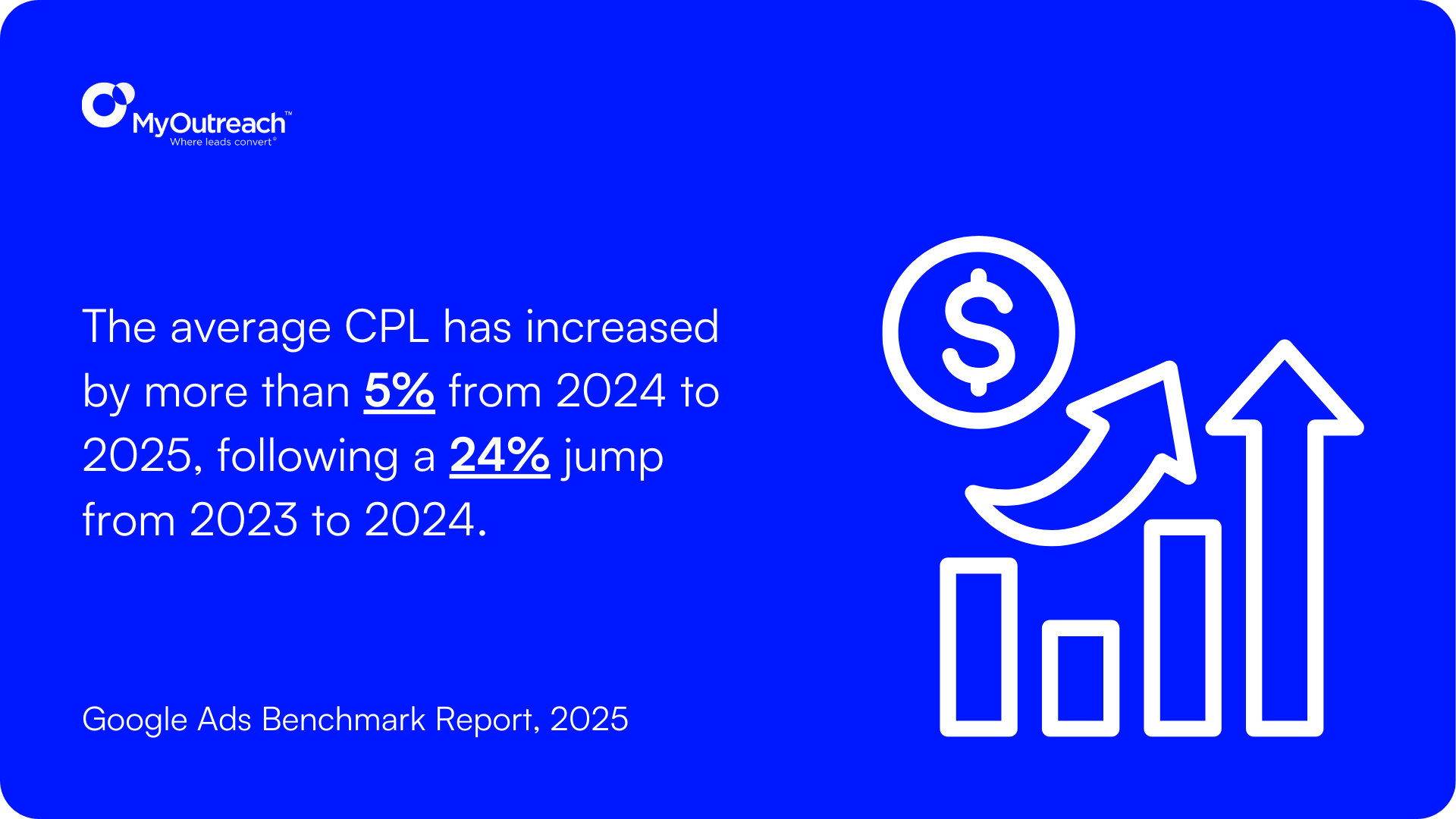
According to the latest Google Ads Benchmark Report, the average cost per lead has increased by more than 5% from 2024 to 2025, following a 24% jump from 2023 to 2024. This reflects a multi-year pattern of CPL growth driven by inflation, automation changes and reduced precision in audience targeting.
Here’s What This Means for The Future
These rising CPL trends are a leading indicator of what we will continue to see in content syndication throughout 2026:
- Demand for first-party lead sources is rising, increasing competition for quality inventory.
- Vendors are passing operational costs to marketers, resulting in higher minimum CPLs.
- Privacy restrictions limit audience availability, raising the value of compliant, engaged decision-makers.
Syndication networks are experiencing higher demand as marketers lean away from high-inflation search, and that demand almost always drives higher pricing.
📖 Useful read: Best B2B Content Syndication Platforms
Cost-Per-Click (CPC) Growing Rapidly
In a similar way to CPL, CPC is rising across various B2B paid media channels, putting pressure on content syndication budgets.
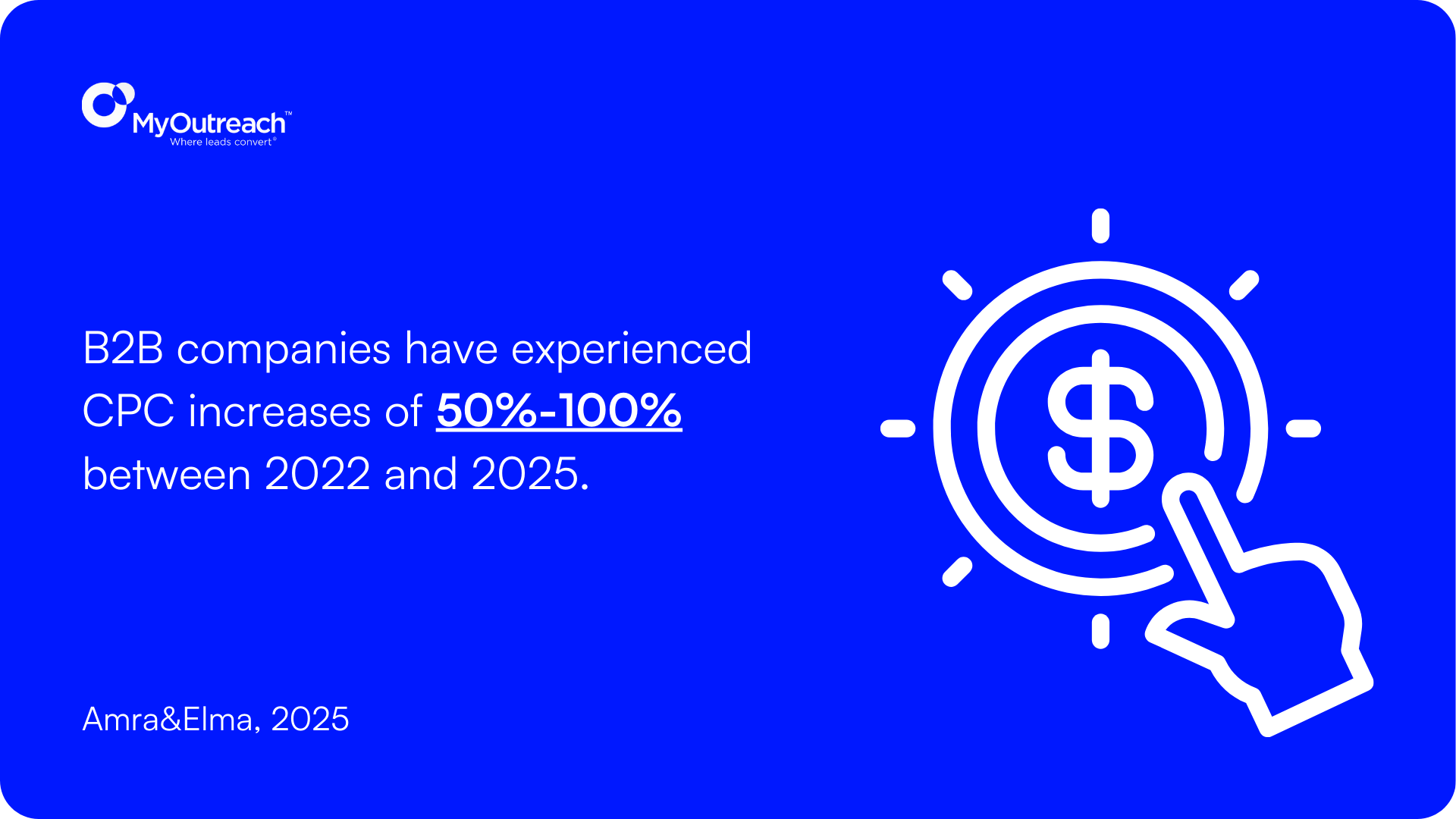
Some B2B companies have experienced CPC increases of 50%-100% between 2022 and 2025, reflecting a dramatic cost inflation in competitive markets.
According to recent industry benchmarks, CPC increased for 87% of industries from 2024 to 2025. Google Search CPC now averages £2.02 in 2025, while B2B focused platforms have even higher rates.
These trends directly impact content syndication programs that use CPC-based pricing models. While many syndication vendors favour CPL models (which currently average from approximately £60 to £75), those relying on CPC are facing increasing competitive pressure. The continuing increase in cost comes from crowded and unstable search conditions.
What to Expect in 2026
This rise in CPC gives a preview of what content syndication buyers can expect throughout the upcoming year:
- Higher CPCs force syndication vendors to optimise for click-to-conversion rather than raw traffic volume, which may limit campaign reach, making traffic quality even more important.
- Increasing bid prices quickly inflate budgets for campaigns that need thousands of clicks, forcing marketers to scale back or accept lower ROI.
- Vendors offer fewer guaranteed impressions at fixed CPCs, putting more performance risk on buyers and reducing potential ROI.
Content syndication remains attractive because it typically offers more predictable pricing. However, as paid advertising faces rising CPCs and unpredictable results, even syndication networks using CPC models are finding it harder to maintain competitive pricing without sacrificing either traffic quality or campaign scale.
Inflation of Flat Campaign Fees
Flat campaign fees are climbing across content syndication platforms, reflecting a wide inflationary pressure, operational costs and stronger demand for high-quality leads. Campaigns that started below £1,600 now often require £2,400-£5,600, as vendors adjust pricing to cover traffic acquisition, compliance, targeting, and engagement quality.
2026 Predictions for Flat Campaign Fees
Vendors are shifting to more predictable revenue structures. While syndication-specific pricing data isn’t publicly published, Gartner research shows that buyers now engage across multiple touchpoints, increasing operational load on vendors.
This complexity is encouraging the adaptation of hybrid pricing models - combining flat campaign fees with performance - or usage-based components. By doing so, vendors can better align pricing with the cost of delivering high-quality leads.
For content syndication, this means:
- Higher baseline fees for campaigns, as vendors account for added targeting, compliance and engagement costs.
- More predictable ROI as hybrid models tie a portion of the performance cost, giving marketers clear accountability for results.
- Strategic planning is important, since campaigns now have to balance fixed costs with expected lead volume and quality.
In 2026, flat campaign fees are expected to continue rising and evolve toward hybrid structures, reflecting both vendors' operational realities and the growing emphasis on revenue accountability from marketing programs.
Content Syndication Pricing Benchmarks for 2026 (Projected + Based on 2024-2025 Data)
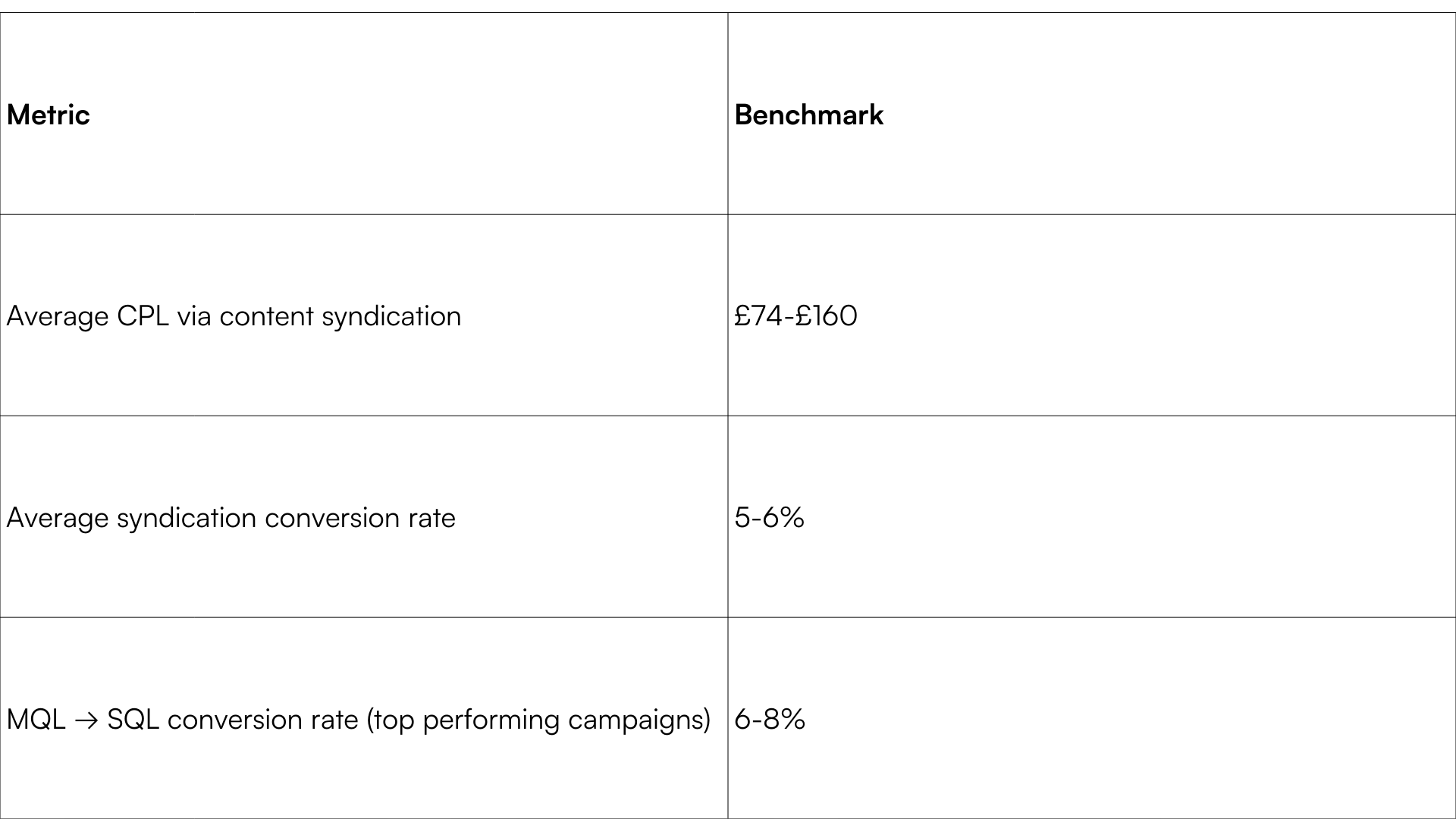
Part of planning an effective content syndication strategy is understanding the current costs and projected ranges. In this section, we'll go over the 2024-2025 benchmarks and the projected 2026 benchmarks.
Recent Benchmarks (2024-2025)
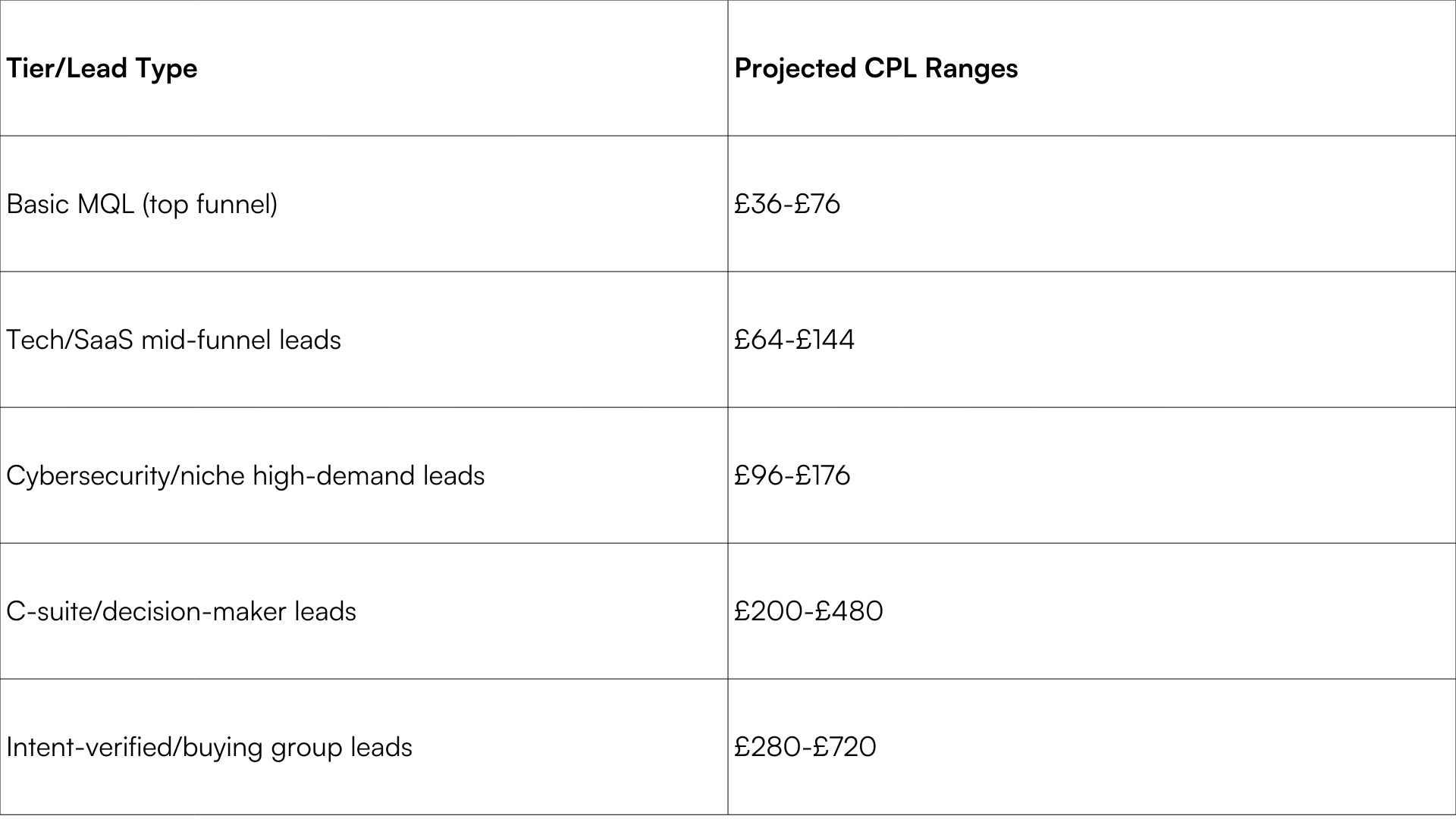
Projected Benchmarks for 2026
Region & Asset Differences
- North America & Western Europe: Premium markets; CPLs skew higher (£76-£720).
- Emerging regions (LATAM, APAC, Eastern Europe, ANZ): Lower CPLs initially (£36-£480), but rising competition may increase costs.
- Content format: Simple PDFs or reports remain cheaper; multi-format, media-rich assets (video, webinars, interactive reports) command premium pricing.
📖 Useful read: An Essential Guide to Distribution Channels for B2B Content Marketing
How ROI is Calculated - What Changes in 2026
Use Multi-Touch Attribution & Lead Scoring
Instead of relying on last-click or last-touch attribution (which can mis-assign credit), more B2B companies now use multi-touch attribution to account for every interaction that contributed to a lead or a sale - content downloads, emails, retargeting, webinars, etc.
Alongside attribution, teams increasingly apply lead-scoring frameworks (combining firmographics, engagement signals, and, when available, AI-validated intent) to differentiate high-quality leads (most likely to convert) from weaker ones. This helps ensure ROI calculations focus on quality and not quantity.
Evaluate Opportunity Velocity
Because B2B buying cycles and buyer committees have grown more complex (as mentioned before), the speed at which leads move from MQL → SQL → Opportunity → Closed-Won is a critical measure of campaign effectiveness.
Measuring pipeline velocity (time to conversion, touchpoint count, drop‑off rates) alongside volume provides a more accurate picture of ROI, particularly as costs (e.g., content production, syndication fees) rise.
Factor in Data Quality & Pipeline Leakage
When you're calculating ROI in 2026, consider data quality - accurate contact information, consent compliance, and valid decision-maker IDs. Higher-quality leads reduce bounce rates, decrease wasted sales efforts, and reduce "pipeline leakage".
When lead validation and enrichment are standard, the effective ROI improves even if CPL is higher. This is because fewer resources are wasted on unqualified contacts.
Compared Against Alternative Channels
Even with rising costs per lead, content syndication might remain more cost-effective than outbound sales, direct ads or high-spend paid-media campaigns.
According to industry benchmarks, strong B2B content‑marketing programs often yield ROI ratios of ~ 5:1 (e.g, £5 in pipeline/revenue for each £1 spent) - a useful starting point when comparing channels.
Use The Classic ROI Formula - But Expand What “Return” Means
Core formula remains: (Revenue - Cost) / Cost × 100%.
But “Revenue” should include not just closed‑won deals, but also influenced pipeline, recurring or upsell revenue, and long‑term value - especially for content or syndication-led programs whose impact may materialise over months.
“Cost” must factor in direct costs (content creation, distribution, syndication fees, ad spend) and indirect/overhead costs (internal labour, tooling, data enrichment, compliance).

Conclusion: What 2026 Means for Content Syndication Pricing
Content syndication pricing in 2026 will reflect a market that's driven by precision, compliance and quality. Rising CPLs, CPC inflation, and hybrid campaign models mean marketers have to plan carefully by focusing on first-party audiences, AI-validated leads, and multi-touch ROI measurements.
While costs are increasing, content syndication remains a powerful, predictable channel for generating high-intent leads and building long-term pipeline value. By understanding pricing trends and benchmarking effectively, marketers can optimise spend and achieve strong ROI.
Use My Outreach to Boost Your 2026 Campaigns
With rising content syndication pricing, it’s more important than ever to partner with a platform that ensures every pound spent delivers high-quality leads and measurable ROI.
My Outreach helps B2B marketers navigate these pricing trends by providing targeted content syndication and multi-touch attribution tracking.
Do you want to know how we can optimise your campaigns, maximise lead quality, and drive predictable results for your business, even as the market evolves? Then, let's chat!
FAQs
Q1: What is the average cost per lead for content syndication in 2026?
Projected CPL ranges vary by lead type: basic MQLs: £36-£76; mid-funnel SaaS leads: £64-£144; niche/high-demand leads: £96-£176; C-suite decision-makers: £200-£480; and intent-verified leads: £280-£720.
Q2: How do CPC trends affect content syndication budgets?
Rising CPCs increase campaign costs for pay-per-click models. Vendors might offer fewer guaranteed impressions, requiring careful planning to maintain ROI.
Q3: Why are flat campaign fees increasing?
Higher operational costs, AI-driven lead validation, compliance, and multi-stakeholder targeting contribute to rising starting fees (£2,400-£5,600), often structured as hybrid models to tie performance to cost.
Q4: How can I measure ROI effectively in 2026?
Use multi-touch attribution, lead scoring, and pipeline velocity metrics. Factor in data quality, compliance, and comparisons across alternative channels to ensure ROI reflects both efficiency and revenue impact.
Q5: Is content syndication still cost-effective despite rising CPLs?
Yes. Syndication remains competitive compared to outbound sales, direct ads, and high-cost paid media, particularly when campaigns leverage high-quality, intent-verified leads.


.webp)

.webp)
.webp)