
The data at a glance
- Personalised subject lines get roughly 46% opens vs 35% for generic ones, and reply rates jump even more.
- Sweet spot for cold outreach is short: 4 to 9 words, under 50 to 60 characters.
- Question subject lines outperform statements. Numbers barely move the needle unless they're specific.
- Selling words like "free", "demo", "save" and "act now" measurably hurt opens. Spam filters catch some of them outright.
- Emojis help in B2C. In B2B they're roughly neutral to slightly negative, and they render inconsistently across inboxes.
- A/B testing subject lines lifts opens by close to 50% on average. Most teams still skip it.
Every subject line listicle promises the magic 50 lines that will fix your open rates. We read a stack of them researching this piece. Most are the same 50 lines with the placeholders swapped. So here's a different approach: fewer lines, more reasoning, and the data behind why a pattern works instead of a bare assertion that it does.
We run email campaigns for clients, so we have a stake in you getting this right. That's the reason to lead with data instead of vibes, not despite it.
What the data says
Personalisation works, and not just first-name personalisation
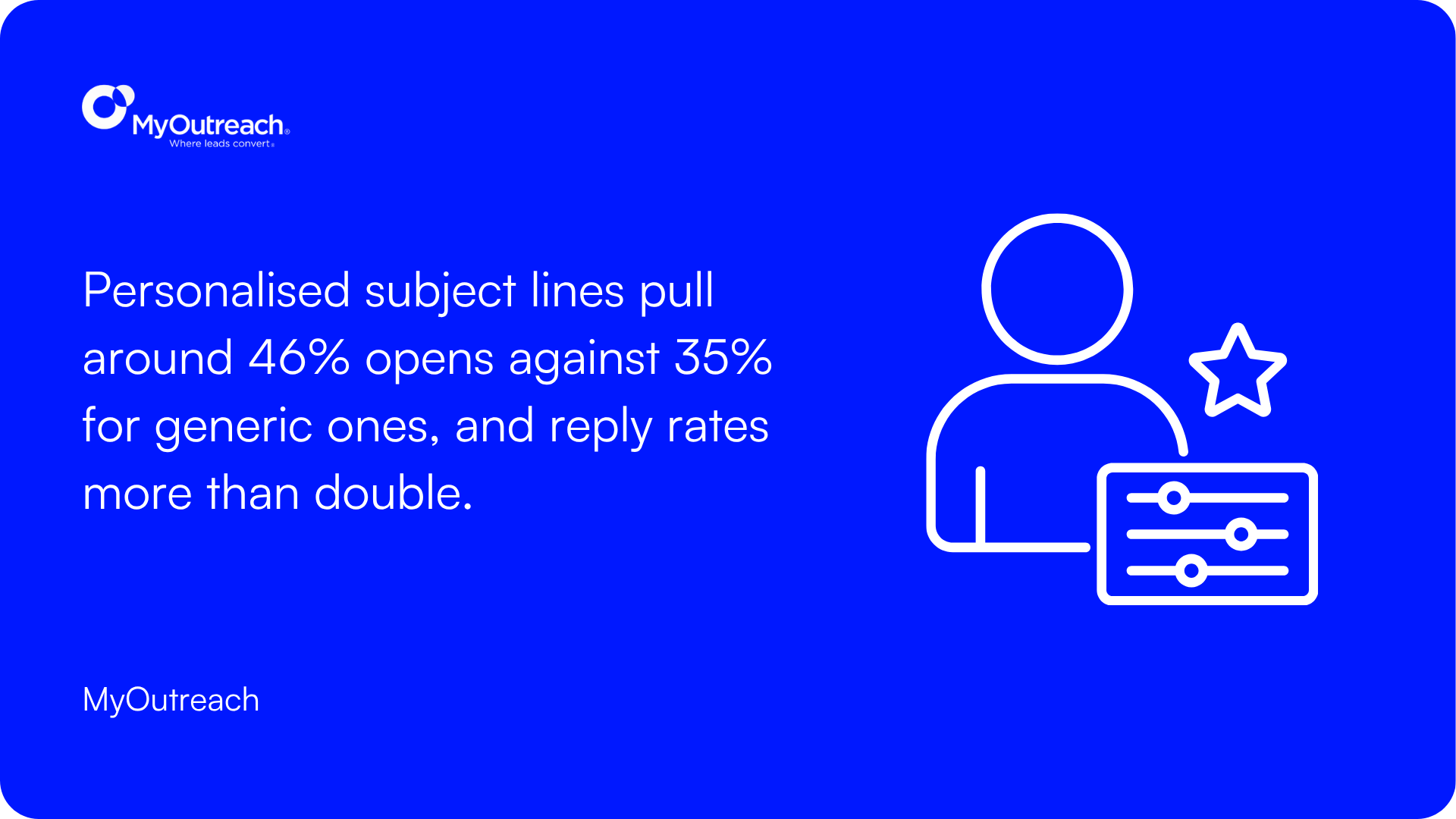
Belkins' analysis of 5.5 million emails found personalised subject lines pull around 46% opens against 35% for generic ones, a 31% lift, and reply rates more than double. But "personalised" needs to mean something beyond {{firstName}}. Role, team size, a recent funding round, a tool they use. A subject line that could apply to anyone isn't personalised, it just has a name token in it.
Short beats long, consistently
Multiple independent studies converge on the same range: 4 to 9 words, roughly 30 to 60 characters. Gong's analysis of 85 million B2B cold emails found subject lines of 1 to 4 words outperformed every longer bracket. Mobile inboxes cut off anywhere past 40 to 43 characters, so anything longer is gambling on the recipient reading on desktop.
Questions outperform statements
Belkins found question-framed subject lines hit around 46% opens, ahead of every other format tested. The mechanism is simple: a question implies the sender wants something specific from the reader, which reads as more human than a broadcast.
Numbers help less than people assume
Some studies show a small lift from currency or specific figures. Others show numbers performing marginally worse than lines without them. Read between the two: a number only helps when it's tied to a real outcome. "$50K saved" works. "5 Ways to Boost Productivity" doesn't, because the number isn't doing anything except making the line longer.
Selling language is the biggest silent killer
Gong found that words like "free", "demo", "save" and "offer" cut open rates by nearly 18%. That's not just weak copy. Several of those words are classic spam-filter triggers too, so you can lose the email before a human ever sees the subject line at all. The same waste shows up in paid channels for the same reason: broad, salesy targeting burns budget the same way a spammy subject line burns a list, which is the whole argument in how B2B programmatic advertising actually works.
Emojis are a coin flip in B2B
One large B2C/B2B comparison found emojis lift open rates by over 50% in B2C and reduce them by around 4% in B2B. They also render inconsistently across Outlook, Gmail and mobile clients, so what looks like a rocket ship on your screen might show up as a blank box on theirs.
Test it, because most teams don't
A/B testing subject lines lifts open rates by roughly 49% on average, one of the biggest single-lever improvements available in email. And it's usually the first thing cut when a campaign is behind schedule. Change one variable at a time, subject line only, same body, same send time, and don't call a test until you've got a real sample. Aim for at least 100 to 200 sends per variant.
Subject lines that work, by what you're trying to do
These are starting points, not scripts. Swap in the real detail (the account's actual pain point, the actual metric, the actual person) or the personalisation data above tells you exactly why it won't work.
Warm nurture and follow-up
For prospects who've already engaged and need a reason to take the next step.
- "Quick question about [specific pain point]"
- "Following up on [topic] you downloaded"
- "[First name], is [goal] still a priority this quarter?"
- "The [industry] gap most teams miss"
- "What's changed since we last talked?"
Why these work: the reader has already raised a hand, so the job isn't to earn attention from scratch, it's to lower the effort of replying. A short question does that better than a statement, because it hands the reader an obvious next action. "Following up on [topic] you downloaded" also carries a built-in reason for the email to exist, which is the difference between a nudge and a nag.
Content and webinar promotion
Getting people into a session or onto an asset without sounding like a mass blast.
- "[Topic] session tomorrow, one seat left on our end"
- "The [industry] data most teams haven't seen yet"
- "New: [specific finding], and what it means for [role]"
- "Worth 20 minutes if you're planning [initiative]"
Why these work: they lead with what the reader gets, not what you're hosting. "The [industry] data most teams haven't seen yet" promises information, which reads as a favour, where "Register for our webinar" reads as a request. Note the absence of "register", "sign up" and "free", all of which are the exact selling words Gong found depress opens.
If webinar promotion specifically is where you're stuck, timing and format matter as much as the subject line, and we've laid both out in our webinar best practices guide. Once people show up, proving the session was worth running is a separate question.
Case studies and proof
Real numbers do the persuading here, so the subject line's only job is to get the number seen.
- "How [similar company] cut [metric] by [percentage]"
- "$[X] saved: the [company] story"
- "What [comparable company] did differently"
- "The [metric] result [company] didn't expect"
Why these work: this is the one place a number earns its keep, because it's attached to a real, specific result rather than a listicle count. "How [similar company] cut [metric]" also does quiet social proof: the reader recognises a peer and wants to know what they know. Keep the superlatives out. Generic hype ("game-changing results!") undercuts every one of these. The number is the hook. Let it do the work and get out of the way.
Re-engagement
For contacts who've gone quiet. The goal is a low-friction way back in, not another pitch.
- "Still relevant, or should I close this out?"
- "[First name], worth reconnecting on [topic]?"
- "Quick check-in before I stop following up"
- "Last note on [topic], then I'll leave you be"
Why these work: they give the reader an easy exit, and counterintuitively that's what earns the reply. A dormant contact expects another chase, so pattern-breaking with "should I close this out?" removes the pressure they were bracing for. That last pattern, giving someone permission to ignore you, consistently outperforms artificial urgency. It reads as respectful instead of pushy, which is rarer in a cold inbox than it should be.
Signal-based cold outreach
The category most listicles skip, and the one with the best data behind it. A subject line that references something real (a hire, a launch, a funding round) reads as researched rather than mass-sent, which is exactly what gets past a recipient's mental spam filter.
- "[Company]'s new [role] hire, quick thought"
- "Saw the [funding/launch] news, one question"
- "[Company] + [your tool], worth a look?"
- "Noticed [specific public signal], relevant to [pain point]"
Why these work: they clear the two bars every cold subject line has to clear at once. The camouflage test, because referencing a real event makes the email read as if it came from inside the reader's world rather than a sales list. And the relevance test, because a genuine trigger means your timing is actually good, not just claimed to be.
This is personalisation in its highest-performing form, the same effect behind Belkins' 46% versus 35% split, applied to someone who's never heard of you. It only works if the signal is true. A fabricated "saw your announcement" line that turns out to be generic will cost you more trust than a plain subject line ever would.
What kills your open rate without you noticing
A few patterns show up across nearly every study we looked at, and they're worth naming because they're easy to slip into without noticing.
Fake urgency
"Act now", "expires today", "final call" trigger the exact scepticism they're trying to avoid, and several are literal spam-filter flags.
ALL CAPS or excessive punctuation
More than a couple of exclamation marks or a fully capitalised subject line reads as spam to both humans and filters.
Fake "Re:" or "Fwd:" prefixes
This can lift short-term opens, and it reliably destroys trust the moment the recipient realises there was no prior thread. Not worth the trade.
Subject and body mismatch
If the subject promises one thing and the email delivers another, you get the open once and lose the account for the rest of the sequence.
Over-personalised tokens
Stacking three or four merge fields into one line ("Hi {{firstName}}, {{company}}'s {{painPoint}} problem") reads as automated precisely because it's trying so hard not to.
Put it into a system, not a swipe file
A good subject line still needs a good list behind it. The best-performing line in the world sent to the wrong person just gets you an unsubscribe with better manners. If your subject lines are landing but your reply rates aren't, the fix usually isn't more subject line testing, it's tighter targeting further up the funnel.
If you'd rather have someone else build and run the campaigns, that's what our B2B email marketing service does end to end, list building, copy, sending and reporting. Get in touch and we'll tell you straight whether your current list needs fixing before a single subject line is worth testing.


.webp)

.webp)
.webp)