.webp)
Events can be expensive. Whether you are looking at organising an executive roundtable, a webinar or even a conference, there is always a question on the mind of every marketer, demand generation executive or event manager: was it worth it?
Most wouldn't be able to give a proper answer. While there may have been great feedback from the attendees or the event may have gone very well, the return on that investment is often difficult to quantify.
That's the event ROI problem. And it's more fixable than most teams think.
What is event ROI?
Event ROI compares the value of an event generated to what it costs to run. Did the benefits outweigh the investment? That's the question return on investment answers.
For events that are directly revenue generating, such as a paid conference or trade show, calculating the return on investment is relatively straightforward. For most B2B events, however, there is no direct revenue generated from the event. Instead, B2B events are used to build relationships with the companies targeted by the event, to move the sales pipeline forward, to establish credibility in the market with the brands that attend the events, and to shorten the sales cycle.
In these cases, an understanding of return on investment must account for both tangible and intangible returns. While revenue is an important return metric, intangible returns may include the establishment of credibility in the market, the growth of relationships with targeted company stakeholders, or even the gathering of market intelligence. These intangible values are also important in generating a return on investment.
Why it matters
Budget conversations
Without ROI data, every event budget discussion is a negotiation based on gut feeling. If you can show that a roundtable generated a specific amount of qualified pipeline at a specific cost, the case for the next one is a business decision, not a faith exercise. That distinction matters a lot when budgets are being cut and event programs are easy targets for people who've never seen the ROI measured properly.
Knowing what works
Not every format delivers equally for every audience. ROI data tells you which event types, topics, and audience profiles generate the best return for your ICP. Which format produces the lowest cost-per-MQL? Which geography converts fastest? The answer varies more than most teams expect, and it's worth knowing before you commit another year's budget to the same mix.
Stakeholder confidence
A company’s stakeholders want to see numbers. While the fact that an event was well-attended or created great engagement from audience members may be satisfying to the marketing and sales departments, stakeholders will want to see metrics such as the total sales pipeline generated by the event, the number of deals influenced by the event, and the number of new leads sourced.
Getting better over time
Measuring ROI consistently builds a baseline you can actually improve against. It replaces post-event debriefs driven by competing opinions with a shared set of facts.
The formula
The basic version looks like this:
(Net Value − Total Costs) ÷ Total Costs × 100
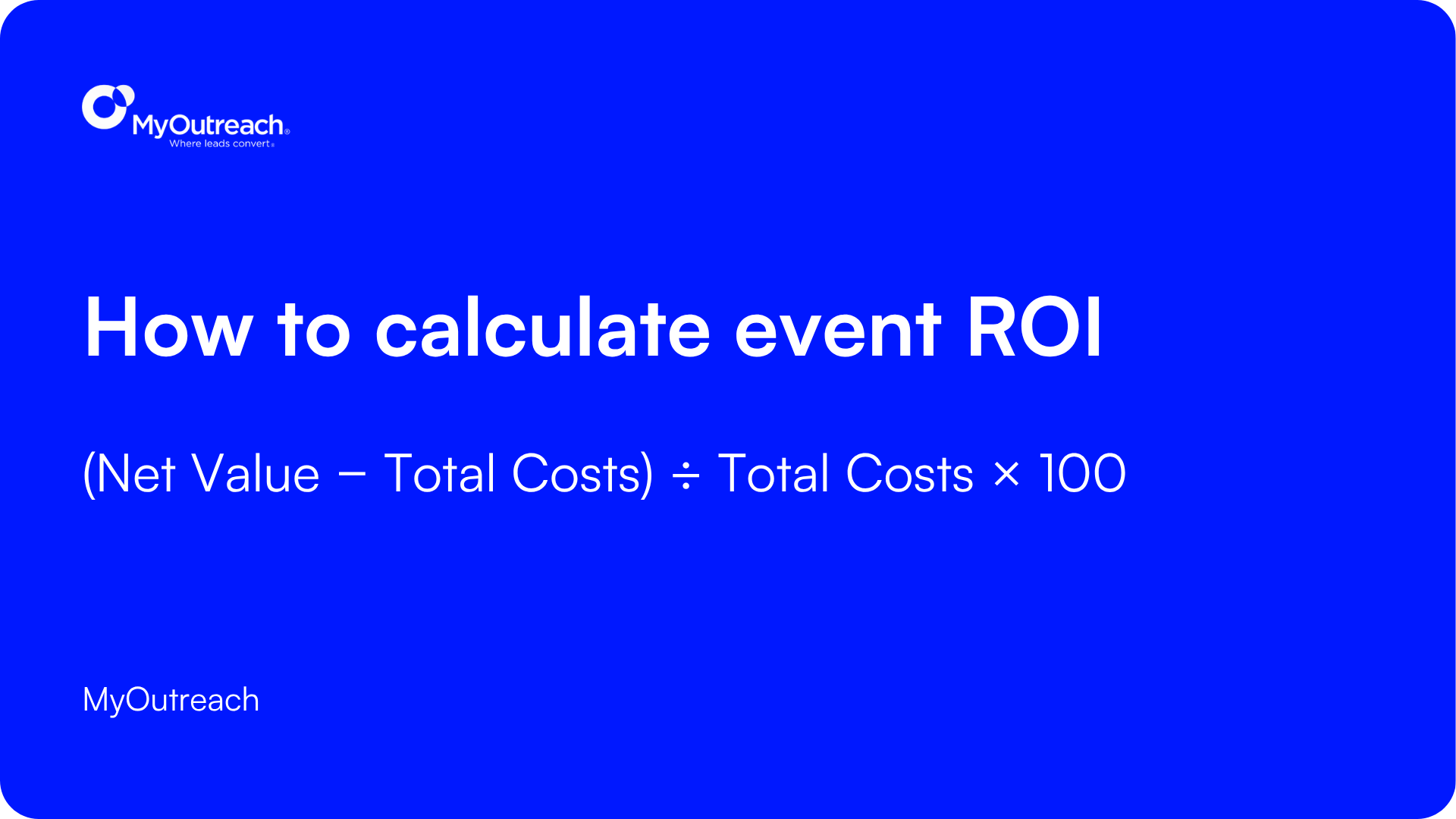
If a company spent £60,000 to host an event and they generate £120,000 in value from the event, their ROI will be 100%. This is the standard calculation for ROI.
The problem is that most B2B marketing events aren't designed to generate revenue on the day. They're designed to start relationships, move pipeline along, build credibility. So a formula that only counts money in versus money spent will undervalue almost every event you run.
A more honest version replaces "net value" with everything you can reasonably quantify: leads generated, pipeline influenced, deals accelerated, press coverage, partnerships formed. Less precise, but it captures what's actually happening.
What goes in the cost column?
Any cost of the event goes into the cost calculation. Costs could include the venue, travel, catering, promotion, technology, event materials, speaker fees, and the time of company staff members.
The time of staff members is a cost that most companies leave out of their calculations; however, a serious event can consume hundreds of hours of senior staff attention between planning, coordination, execution, and follow-up. Leave that out and the numbers look better than they are, which makes the data useless for actual decision-making.
What goes in the value column?
Direct revenue if there is any, sponsorship income, pipeline generated, deals that closed in the months following, leads and their quality against your ICP, estimated media value, web traffic lift, and the harder-to-price stuff: relationships formed, market intelligence gathered, brand perception shifts. The tangible things get a number. The intangibles get acknowledged (more on that below).
Tangible vs. intangible returns
The tangible metrics for an event can be incorporated directly into the return on investment calculation. The intangible metrics need to be evaluated differently.
Relationships
A well-run executive dinner creates a quality of connection that email can't touch. When the right decision-makers spend a few hours together in a properly facilitated environment, the resulting trust shortens sales cycles and makes renewals stickier.
It doesn't appear in the 30-day attribution report, but it shows up over the following 12-18 months in deal velocity and retention rates. The compounding nature of relationship-driven revenue is one of the stronger arguments for sustained investment in high-touch formats.
Brand credibility
Running a high-quality event in your space makes you the company that brought those conversations together. Buyers remember who organized the best roundtable on the topic they were wrestling with. It influences shortlists in ways that are genuinely hard to trace back to a single event, but it doesn't make it any less useful.
Market intelligence
One of the best ways of gathering market intelligence in B2B sales and marketing is through roundtable discussions with industry executives. These discussions allow you to understand the issues that those executives are facing in their companies.
Behaviour change
Events work by changing what people do next. Did a webinar prompt a prospect to book a demo? Did a roundtable accelerate a procurement decision that had been sitting still? Did a product briefing give an internal champion the language to sell your solution upward? These downstream effects are where events earn their ROI, even when the attribution trail is messy.
Key metrics
Pipeline and leads: leads captured, quality score against ICP, MQLs and SQLs generated, cost per MQL, pipeline value attributed, time-to-close compared to other channels.
Attendance and engagement: registrations vs. actual attendance, ICP match rate, session participation (polls, Q&As, networking), dwell time for virtual events, NPS, post-event survey scores.
Brand: press mentions and estimated ad value equivalent, social impressions and engagement, branded search uplift, website traffic tied to event activity.
The three levels of event ROI
Before getting into measurement, it helps to understand that event ROI operates at three levels. Most event measurement lives at Level 1. Good event measurement tracks all three.
And the way you get from Level 1 to Level 3 is by building the tracking infrastructure before the event happens.
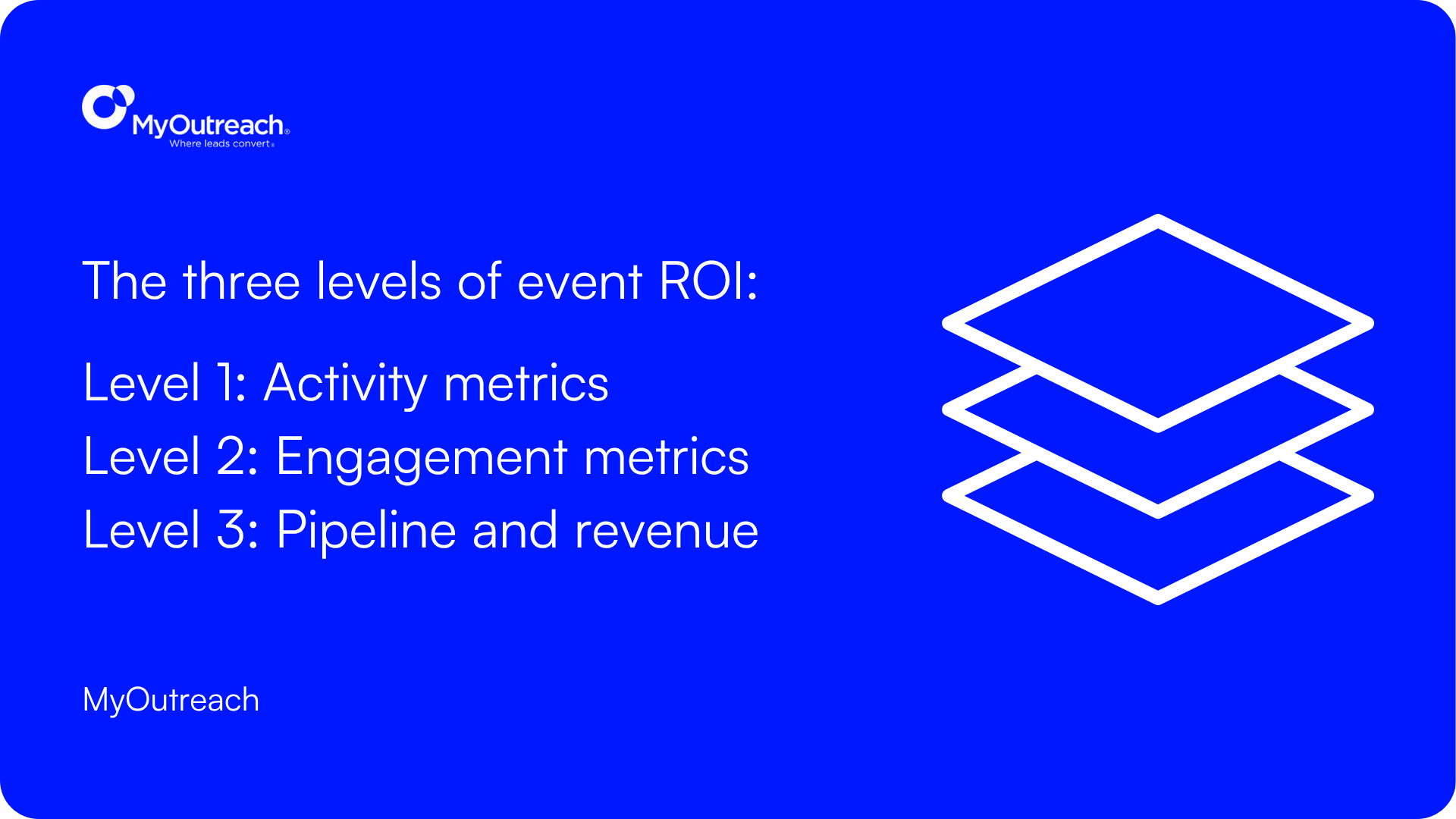
Level 1: Activity metrics
Attendance, registrations, sessions attended, booth visits, badge scans. These tell you whether the event happened. They don't tell you whether it worked.
Level 2: Engagement metrics
Qualified conversations, meeting bookings, content downloads, demo requests on the day. These tell you whether the right people showed up and engaged.
Level 3: Pipeline and revenue metrics
Opportunities created, pipeline influenced, deals accelerated, revenue closed. This is the only level that actually answers "was it worth it?"
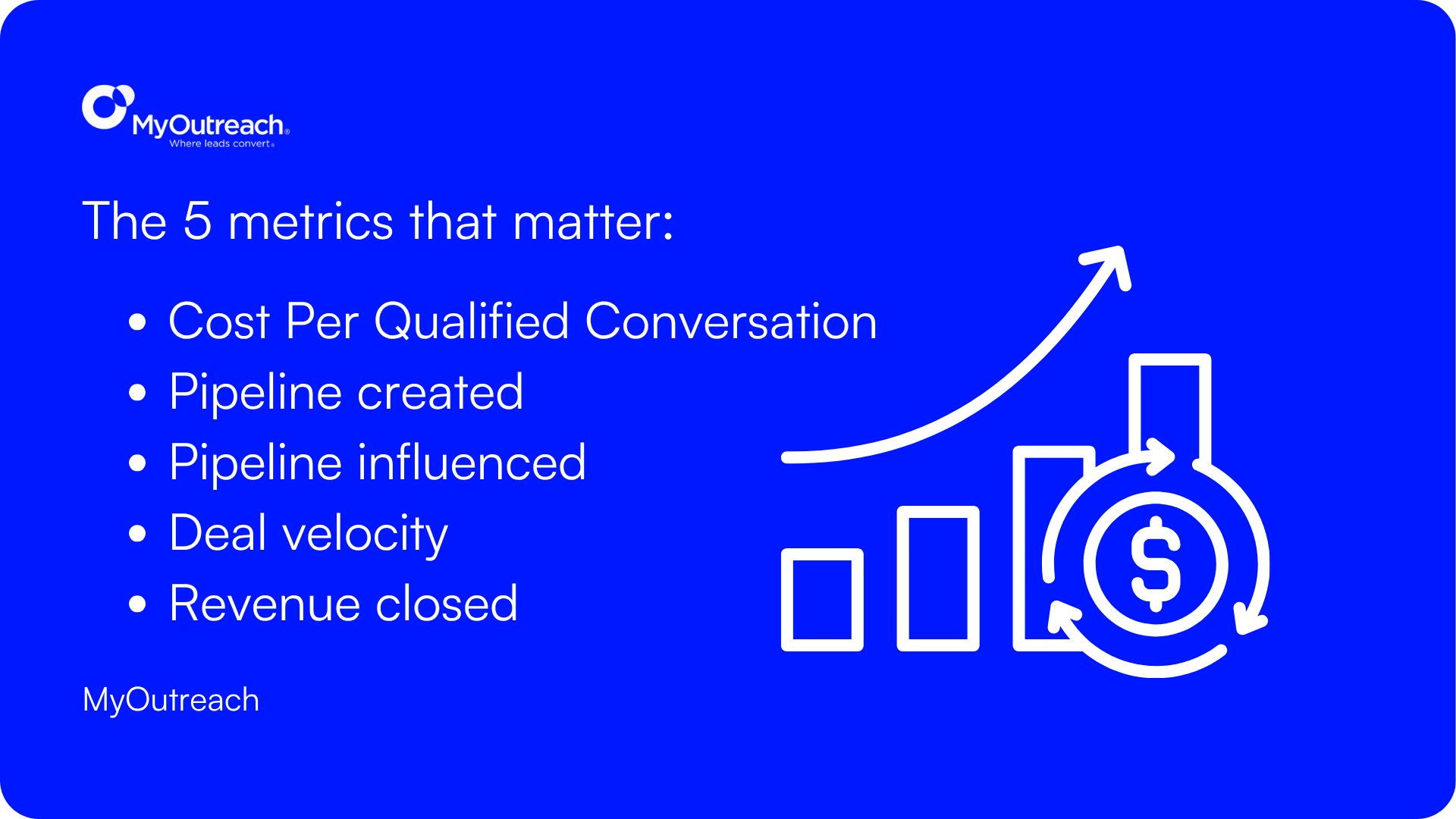
The five metrics that matter
There are five metrics that relate event activity to revenue. Most companies track some of them. The few that get the most out of their events track all five.
Cost Per Qualified Conversation
Total cost of the event divided by the number of qualified conversations you had at the event. If this is lower than your cost-per-qualified-conversation rate from other channels, your event is working.
Pipeline created
The value of the pipeline that was created within 30-60 days of the event from people who attended the event. This requires tagging every attendee in your CRM before the event so you can run the report afterwards.
Pipeline influenced
Deals already in progress where the event played a role in advancing them. For most companies running executive events or roundtables, pipeline influenced will be 3-5x larger than pipeline created. It's the metric that justifies the relationship-building events that are harder to attribute directly.
Deal velocity
Are the deals involving attendees of your company closing faster than deals with companies whose prospect did not attend your event? If so, you have a real value metric for your event, even if you would have still closed those deals at the same rate.
Revenue closed
Total revenue closed from opportunities where an event was the source or a significant influence touchpoint. This is the number that definitively answers the ROI question. It takes time to mature (most event-sourced revenue closes 60-180 days after the event) but it's worth tracking consistently.
How to measure it
Know what you're measuring before starting
This sounds obvious, but it gets skipped constantly. Before a venue is booked, marketing and sales need to agree on what success actually looks like in specific terms.
"Generate leads" is not a goal. "40 MQLs from VP-level contacts at 500+ person companies, 30% converting to SQL within 90 days" is. This difference matters because it's the only way to ensure both teams are evaluating the same event against the same standard.
Match your metrics to your goals
If the goal is pipeline, you're tracking leads captured, ICP match rate, pipeline value attributed, and how fast those deals move in the following quarter. If the goal is brand positioning, you're tracking share of voice, press mentions, and how attendees describe you in post-event surveys. Mixing these together, or running one scorecard for everything, produces reporting that doesn't tell you much.
Track costs from day one
Someone on the team needs to own a live cost tracker, starting the moment planning begins, including staff time. A realistic estimate of internal hours spent planning, attending, and following up should be in the spreadsheet alongside the venue invoice.
Capture data before, during, and after
Before the event: Cross-reference your registration list against your target account list. Knowing your ICP match rate going in, rather than discovering it afterwards, changes how you brief the team.
During: Capture who engaged with what, which accounts were active in discussion, and anything from conversations that sales needs to know.
After: Send surveys within 48 hours, tag leads in your CRM with the event source, and review pipeline at 30, 60, and 90 days. Most B2B deals that originate from events take at least two months to show up in the numbers. Declaring underperformance at two weeks is just looking in the wrong place.
Sort out attribution before the event
Picture the scenario: a deal closes four months after your roundtable, but the prospect also attended a webinar, received a dozen nurture emails, and took three sales calls in between. Who gets credit? If you haven't agreed on an attribution approach upfront, that question turns into an argument.
Multi-touch attribution is closer to reality than giving all credit to one touchpoint. What matters more than the model is that everyone agrees to it before the data exists.
Set up your CRM before the event runs
The tracking only works if the infrastructure is in place first. Tag every confirmed attendee in your CRM as a campaign member before the event — create the campaign record, upload the attendee list, and ensure every contact is linked to it. Brief your sales team on conversation logging during the event: who they spoke to, what was discussed, what the agreed next step was. That data needs to be in the CRM within 24 hours of the event ending. Define what "qualified" means with sales before you go, not after — otherwise you come back with a list of contacts that sales won't act on. And set your attribution window in advance: pipeline created within 60 days, pipeline influenced within 90. Changing the window after the event to make the numbers look better is how you lose credibility with your CFO.
ROI by format
Executive roundtables produce the best pipeline quality of any B2B format. Volume is low by design, that's the entire point. Cost-per-qualified-conversation, conversion rates, and time-to-close consistently outperform other formats. The variable that makes or breaks a roundtable is who's in the room. An intimate event with the wrong attendees fails on its primary purpose entirely.
Virtual webinars offer scale that in-person can't touch. The trade-off is depth: people watching a screen while answering emails form shallower relationships than people sharing a meal. Webinar leads need more nurture, and the pipeline conversion timeline is longer. Fast, personalised follow-up to the most engaged attendees is where webinar ROI is actually made.
Breakfast and lunch briefings sit between roundtables and conferences in terms of intimacy and scale. They work well for mid-funnel nurture with prospects who already know your brand but aren't ready for a formal sales conversation. The format gives both sides a natural reason to meet.
Trade shows generate volume. They rarely generate quality at a competitive cost-per-lead. ROI depends heavily on pre-booked meetings with target accounts and how quickly and relevantly sales follows up after the show. Badge scans without a structured follow-up process are just a list of names.
Hospitality events, like golf days, dinners, or curated experiences are best measured against account retention and expansion rather than new pipeline. The lifetime value of a retained strategic account comfortably exceeds the cost of a well-run experience event.
What good event ROI looks like
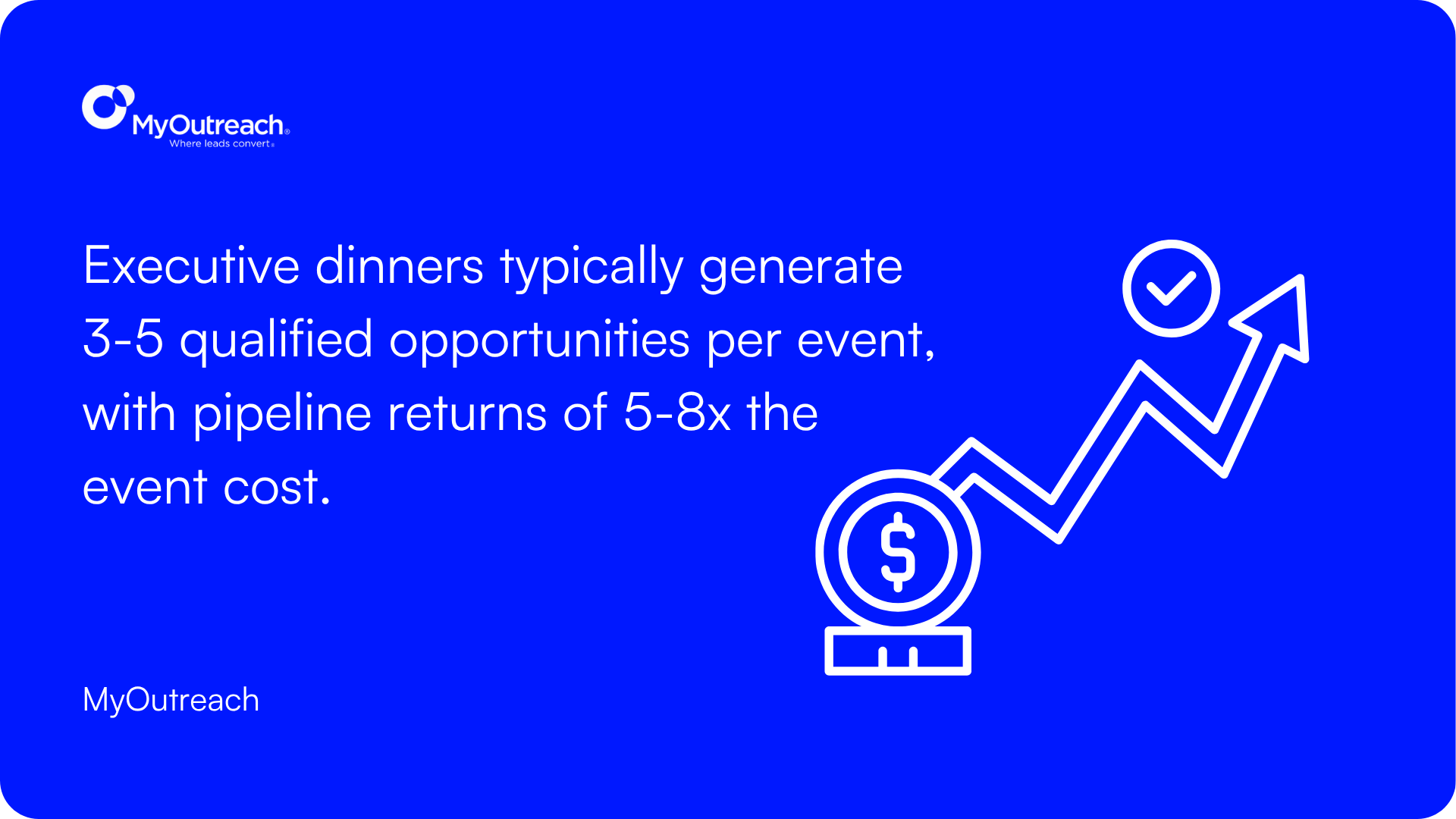
There's no universal benchmark, it depends on your ACV, sales cycle length, and event format. But these are the directional numbers worth aiming for:
- Executive dinners (10-20 people): 3-5 qualified opportunities per event, pipeline multiple of 5-8x event cost
- Roadshows (40-80 people): 8-15 qualified opportunities, pipeline multiple of 4-6x event cost
- Larger field events (100+ people): pipeline multiple of 2-4x event cost, with deal velocity improvement as the secondary metric
If you're not hitting a pipeline multiple of at least 3x event cost within 90 days, something in the model needs to change — audience quality, format, follow-up speed, or sales engagement.
Common mistakes
Measuring too early
B2B pipeline takes time. Significant outcomes from a well-run event often appear 60–90 days later as conversations develop and buying processes move forward. Two-week ROI reviews on relationship-based formats are not a fair test. Build 30, 60, and 90-day reporting windows into your standard process from the start.
Reporting on vanity metrics
Registration numbers and social impressions are easy slides to build and largely useless for demonstrating commercial value. An event with 300 registrations and no qualified pipeline is worse than one with 20 attendees and three pipeline conversations. .
Leaving out internal time
A major event easily consumes 200-400 hours of senior staff time across planning, coordination, delivery, and follow-up. Ignoring this inflates ROI figures, makes it impossible to honestly compare events against other marketing channels, and generally produces the kind of numbers that unravel as soon as someone starts asking questions.
Treating all leads the same
A badge scan at a trade show and a 45-minute conversation with a CTO at a hosted roundtable are not equivalent leads and should never be counted as such.
Not briefing sales before they follow up
The handoff between marketing and sales after an event is where most ROI is won or lost. Reps who know who attended, what was discussed, and which accounts were most engaged make more effective calls than reps working from a cold list.
How MyOutreach does it
Our events are built around one thing: getting the right people in the room, then making sure the commercial outcomes follow.
For executive roundtables, we handle delegate acquisition from a database of 189M+ verified contacts, venue, catering, moderation, and logistics. We use 6,000+ intent signals to identify prospects actively researching solutions in your category. Not just people who match your firmographic profile, but people who are currently in-market.
Every lead across both formats carries a 100% valid lead guarantee. Anything that doesn't meet our verification standards gets replaced or refunded.
If you want to talk through how good event ROI looks like for your program, get in touch with us.
.jpg)


.webp)

.webp)