.webp)
B2B programmatic advertising is automated buying of digital advertisements. It places your brand in front of the specific individuals who are involved in making purchasing decisions within your target company accounts.
Done well, it builds pipeline by reaching the right buyers during the anonymous research phase before they ever contact your sales team.
Done poorly, it burns budget on irrelevant audiences and generates impressive-looking metrics that never touch revenue. The difference mostly comes down to targeting discipline, intent data, and being honest about what the channel actually does.
What programmatic advertising actually means
Programmatic advertising is the process of automatically buying ad placements. Instead of negotiating placements manually with publishers, your ads are purchased and placed in real time through software. This typically uses a demand-side platform that bids on available impressions across an ad exchange.
The whole transaction takes only a few milliseconds. Someone loads a page with ad inventory, the exchange runs an auction, your DSP decides whether to bid and at what price, and the user either sees your ad or doesn't. All of this happens in the background, so the users don’t notice anything about the whole process.
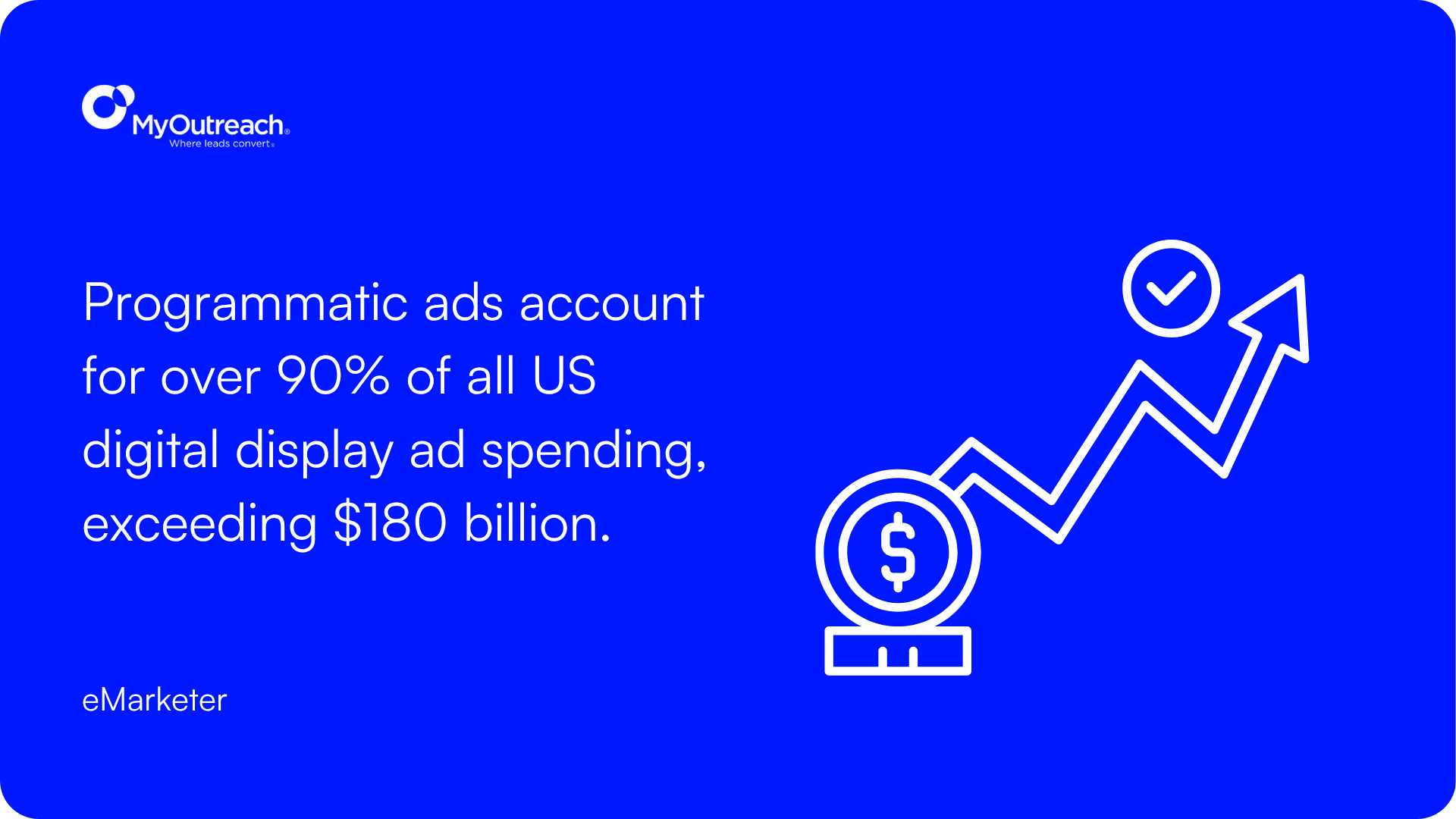
Programmatic accounts for over 90% of all US digital display ad spending, with projected spend exceeding $180 billion in the next year. It's the default infrastructure for digital advertising at scale. The question isn't whether to use it, it's whether you're using it well.
B2C programmatic advertising is reasonably well understood. You can define your audience, push your ads at scale and iterate on what converts. Volume is your friend as conversion cycles are short and feedback loops are tight.
B2B doesn't work like that. Treating it as if it does is where many B2B companies waste their advertising budgets.
Why B2B programmatic is a different problem
In B2B, you're not selling to an individual browsing in a purchase mood. You're trying to reach a specific person, at a specific company, at a specific point in a buying process that averages around 10 months for most deals and stretches past 17 months for complex technology purchases. And that person is probably one of several people whose opinion matters.
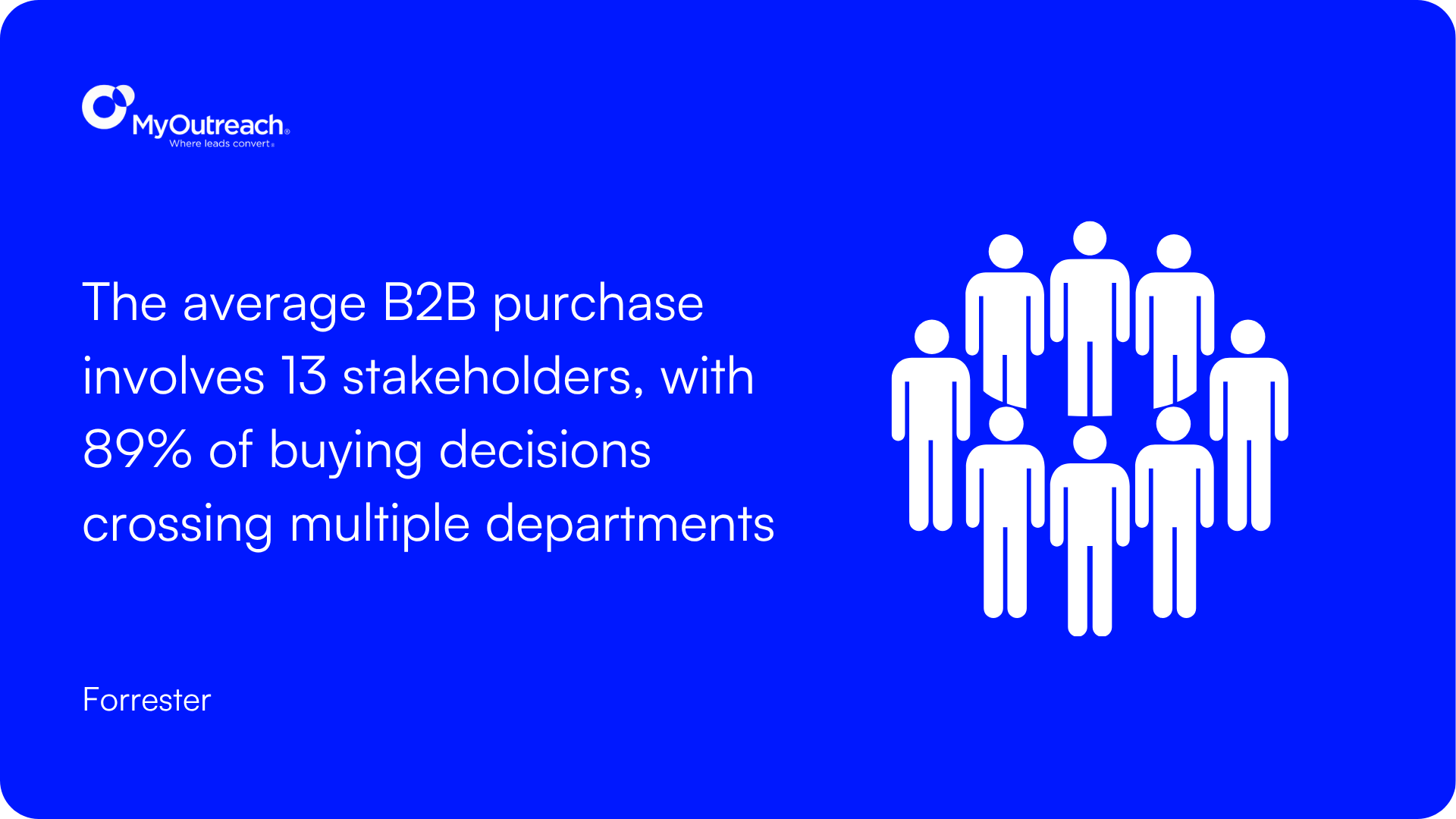
The average B2B purchase now involves 13 stakeholders, with 89% of buying decisions crossing multiple departments.The point is: reaching one person at a target account and hoping they carry your message internally is not a strategy.
There's also the timing problem. 6sense's 2025 Buyer Experience Report, which surveyed nearly 4,000 B2B buyers, found that buyers contact vendors at around the 61% mark of their buying journey. They've already done their research, they've already built a shortlist, and 81% already have a preferred vendor in mind before they ever reach out. That vendor is on the shortlist because of awareness built before the sales conversation started.
This means two things for B2B programmatic. First, your ads need to be doing brand work long before an account enters a formal evaluation. Second, reaching the right accounts early on matters far more than hitting a broad audience efficiently.
The common ways B2B programmatic budget gets wasted
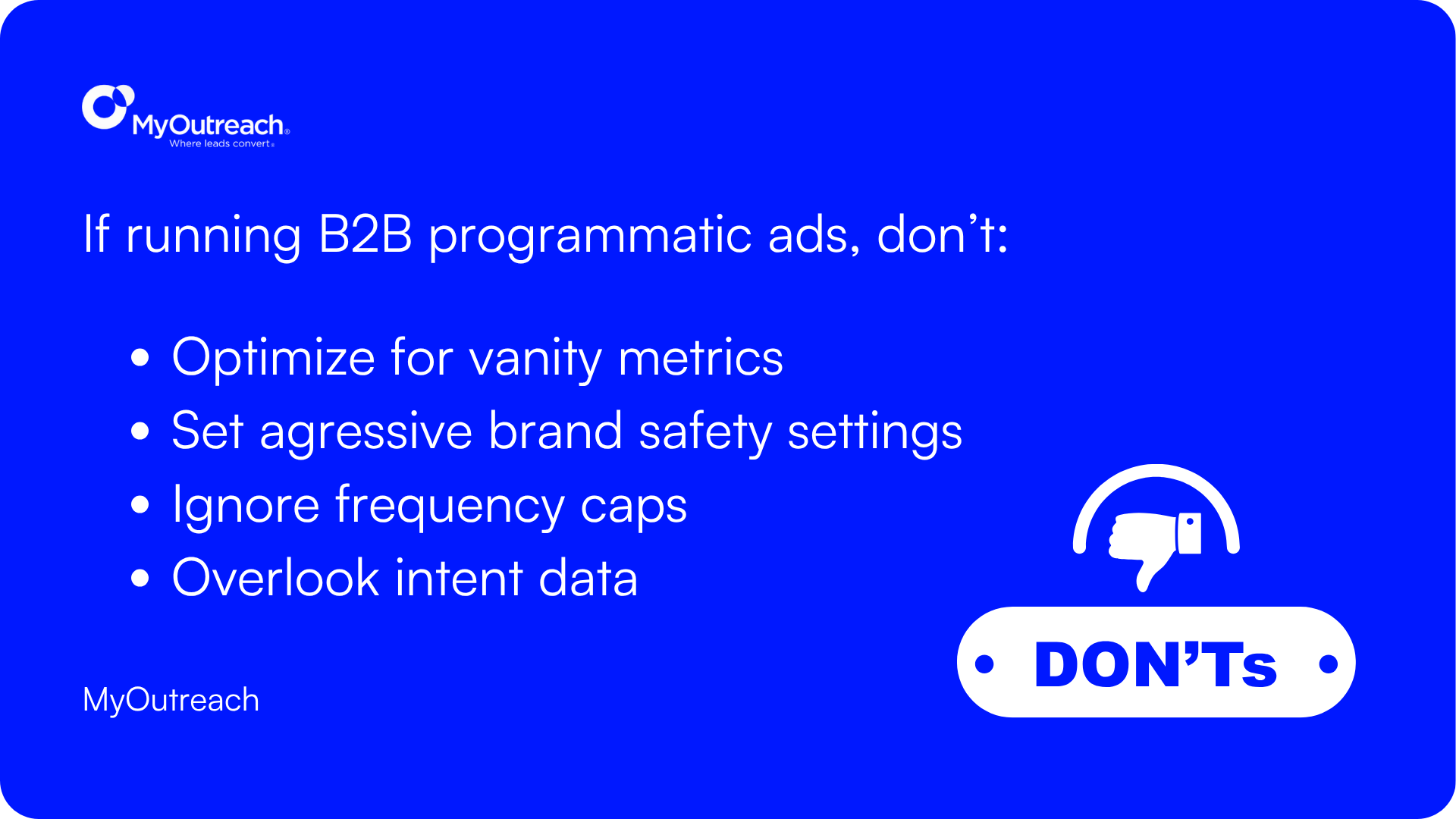
Optimizing for the wrong metric
Click-through rate feels like a useful optimisation target. In B2B, it isn't. The placements that generate clicks from business audiences are often not the ones generating qualified attention from the people you actually want.
What this means, is that if you are optimizing for CTR, your ads might show up on clickbait sites for curious but badly targeted audiences.This results in low costs per click, but no effect on pipeline.
Instead, optimize for outcomes that map to your actual goal: qualified site visits from target accounts, content downloads from companies on your Target Account List, or engagement from people who match your ICP. This requires tracking that goes beyond session analytics and a willingness to spend some budget in a learning phase before the campaign gets efficient.
Brand safety settings that are too aggressive
Brand safety filters are supposed to stop your ads appearing next to offensive content.
That's reasonable, but many B2B advertisers apply them so broadly that they exclude most of the legitimate content where their actual audience spends time. You end up serving ads in a very clean, very empty corner of the internet.
Ignoring frequency caps
Ad frequency is one of the most neglected settings in B2B programmatic. Too few impressions and you don't build enough recall. Too many and you become noise, or you irritate the exact people you're trying to win over.
Running without intent data
Running B2B programmatic without intent signals is close to guesswork. You're broadcasting at a market with no real signal about who's in a buying motion and who isn't.
Intent data tells you which companies are actively researching topics related to your product right now. Which accounts are consuming content about a specific pain point. Which job titles are spending elevated time on topics adjacent to what you sell.
When you layer that onto your programmatic targeting, you stop reaching a demographic and start reaching people who are actually evaluating solutions in your category.
A Rollworks and Bombora study found that 96% of B2B marketers report success when using intent data to achieve their marketing goals. That number reflects what happens when you remove accounts that aren't in-market from your targeting pool and focus spending on the ones that are.
What good B2B programmatic targeting actually looks like
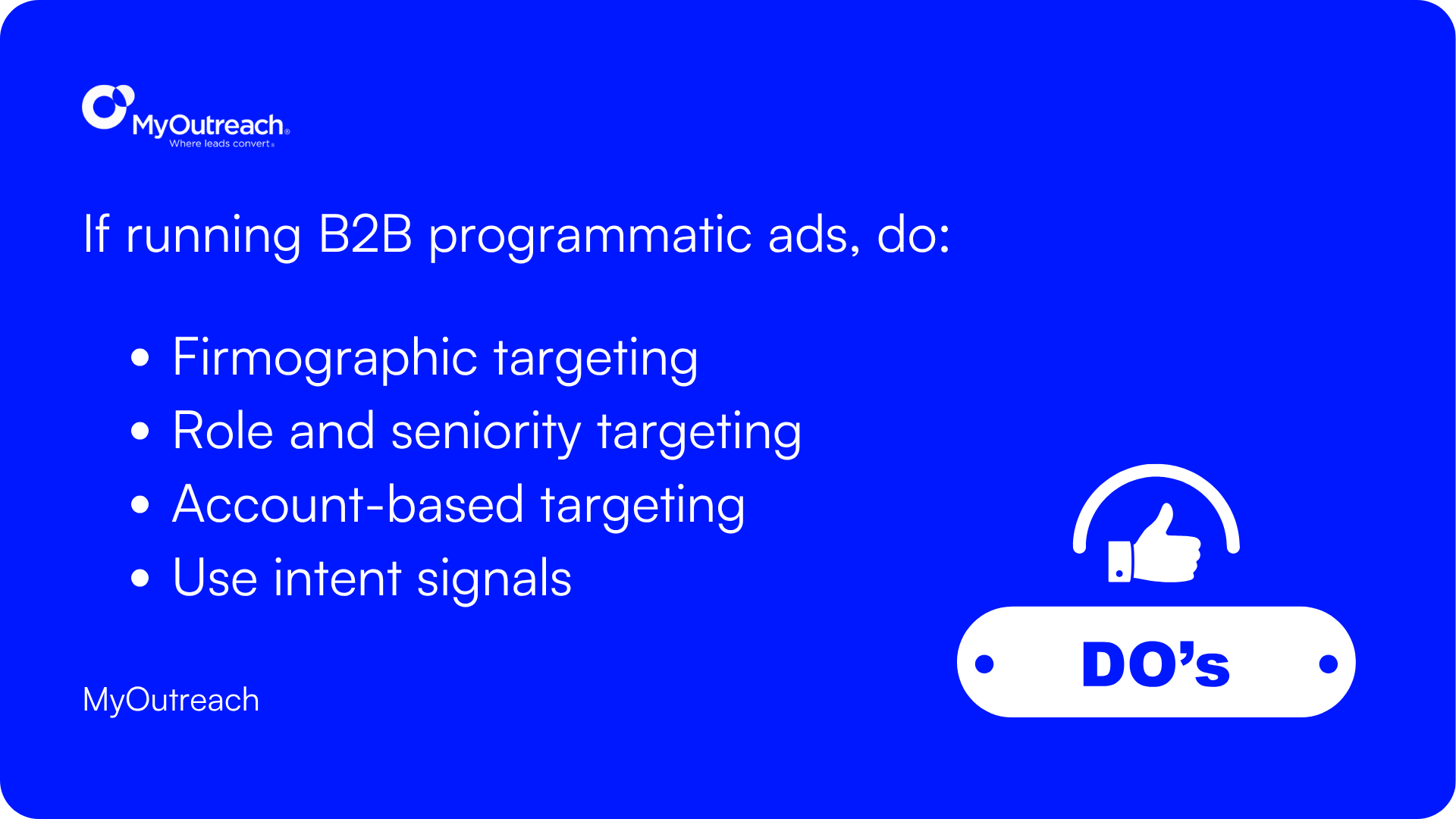
Firmographic targeting
This is where you start. Company size, industry, revenue range, tech stack, geography. This filters out the huge portion of the internet that is definitionally not your buyer.
A company selling cloud security to mid-market financial services firms doesn't need impressions at SMBs or healthcare organisations. Excluding them from the outset makes every pound of budget work harder.
Role and seniority targeting
This narrows your pool from companies to people. The challenge is that job title targeting on most programmatic platforms is imprecise on its own. Many people's ad profiles don't accurately reflect their actual job. This is why role targeting needs to sit on top of firmographic filters rather than doing all the work by itself.
Intent signals
There are two broad types.
First-party intent comes from your own properties. People visiting your pricing page, downloading specific content, returning to your site multiple times. High-confidence signals, but by definition, you only have them for people who've already found you.
Third-party intent comes from data aggregators tracking behaviour across large publisher networks. When a company's employees are consuming elevated volumes of content around a specific problem category, that behavioural shift is captured and becomes targetable. This is how you reach buyers before they've found you, rather than retargeting the ones who already have.
Account-based targeting
This is the layer that brings it all together. Rather than defining an audience by characteristics and hoping the right companies happen to match, you work from a Target Account List of specific companies you want to reach, and use programmatic to serve ads to people at those companies specifically.
IP-based targeting has gaps because remote work and VPNs create real coverage problems, but it's the most efficient use of budget when your TAL is well-defined and your ICP is clear.
At MyOutreach, we track over 6,000 intent signals across the SaaS industry, combining first-party data with signals from 30+ publications. That's the signal depth that makes account-based B2B programmatic targeting actually precise rather than just directionally useful.
Choosing the right creatives for B2B programmatic
Specificity always outperforms vague claims. "Reduce procurement cycle times by 35%" does more work than "Streamline Your Operations." It self-selects for relevance. The right people engage. The wrong people scroll past, which is what you actually want.
Problem-language connects better than solution-language. The words your target audience uses to describe their pain are more persuasive than polished marketing language developed internally.
Sequential creative is worth the extra production effort if your DSP supports it. Ads that run as a series, problem first, solution second, proof third, map better to how B2B awareness accumulates than a single static message repeated indefinitely.
Measurement and attribution
The measurement of B2B programmatic ads is genuinely difficult, and anyone who makes it sound simple is oversimplifying.
The core issue is attribution. Programmatic advertising in B2B contributes to pipeline in ways that rarely appear in last-touch models. Someone sees your ad. They don't click. Months later, during a vendor evaluation, they search for you directly, download a whitepaper, get an SDR call, attend a demo, and sign. The programmatic impression gets zero credit. The SDR gets all of it.
This consistently causes B2B teams to underestimate programmatic's contribution. You need proxy metrics to judge whether the channel is working while proper attribution develops.
Useful proxies are:
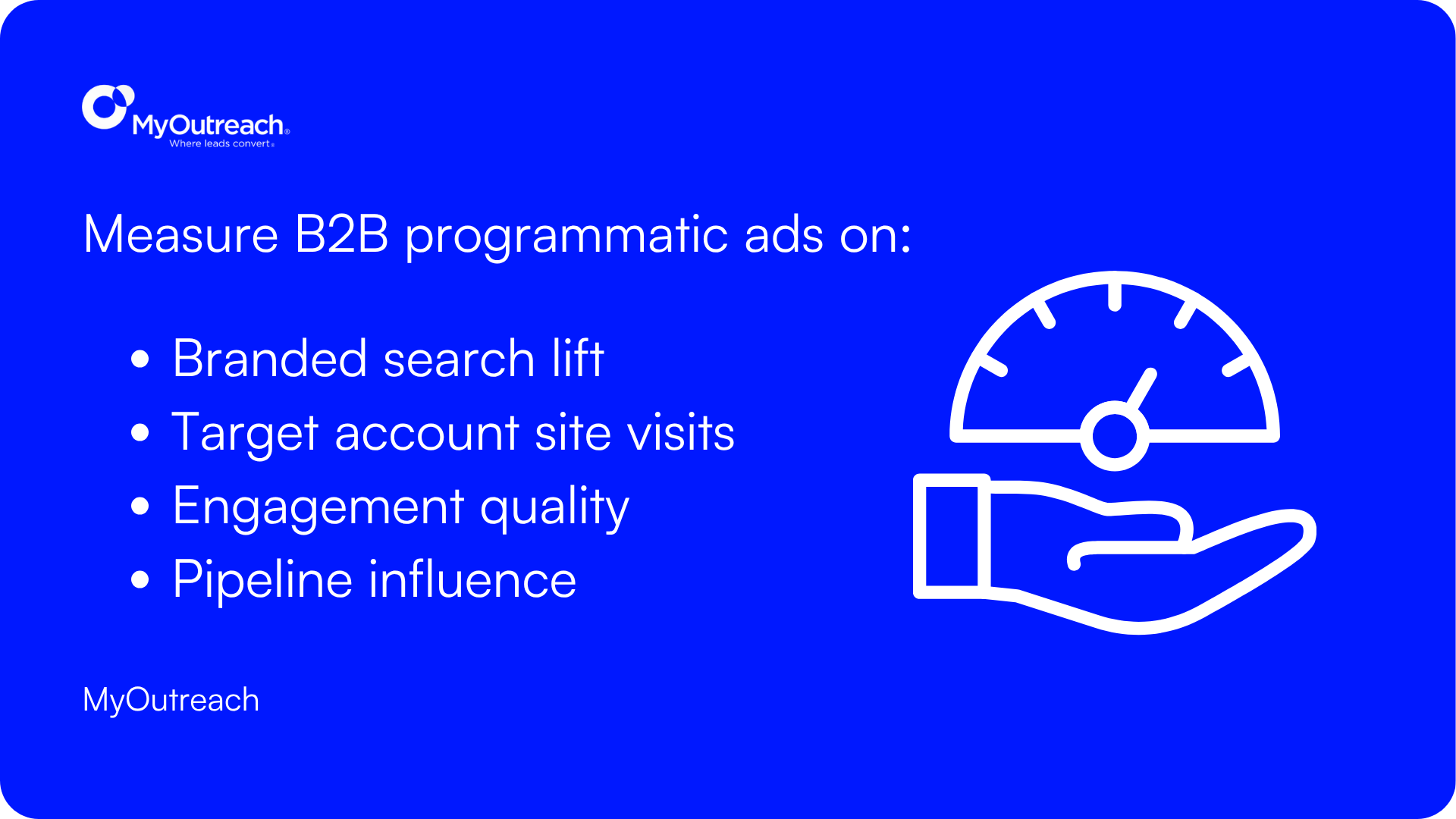
- Branded search lift: Establish a brand search volume baseline before the campaign, then monitor for increases during and after. If your B2B programmatic campaign is building awareness in target accounts, you'd expect more branded searches from those companies over time.
- Target account site visits: If you're running account-based targeting, use your web analytics to measure visit rates from companies on your TAL. An increase correlates with the campaign doing its job.
- Engagement quality: Track time on page, pages per session, and content download rates specifically for programmatic-sourced traffic. If people are bouncing immediately, either the creative promise doesn't match the landing page, or the targeting is off.
- Pipeline influence over 90 to 180 days: Look at whether opportunities opened from accounts that were in your programmatic TAL during the campaign period. This isn't clean attribution, but it's a reasonable indicator of directional contribution.
What you shouldn’t obsess over in isolation: impression volume, CPM, and raw click-through rate. These are inputs, but don’t tell you whether the channel is generating business.
Where programmatic ads fit in the wider stack
B2B programmatic advertising doesn't work in isolation. It performs best as one layer in a coordinated demand generation campaign.
For cold accounts that don't know you exist, programmatic does awareness work. It puts your name and your category language in front of the right people repeatedly, so that when they eventually enter a buying cycle, you're not starting from zero.
For warm accounts that have had some exposure to you, or that intent data signals are actively evaluating, programmatic reinforces the other channels doing more direct work. Your SDRs are calling. Your content syndication is reaching their decision-makers. Programmatic adds another consistent presence across the channels those people use.
For in-cycle accounts actively comparing vendors, programmatic keeps you visible during the evaluation period, especially to buying committee members who aren't directly engaging with your sales team.
Necessary infrastructure
Even solid targeting falls apart without the right foundation underneath it.
Landing page alignment
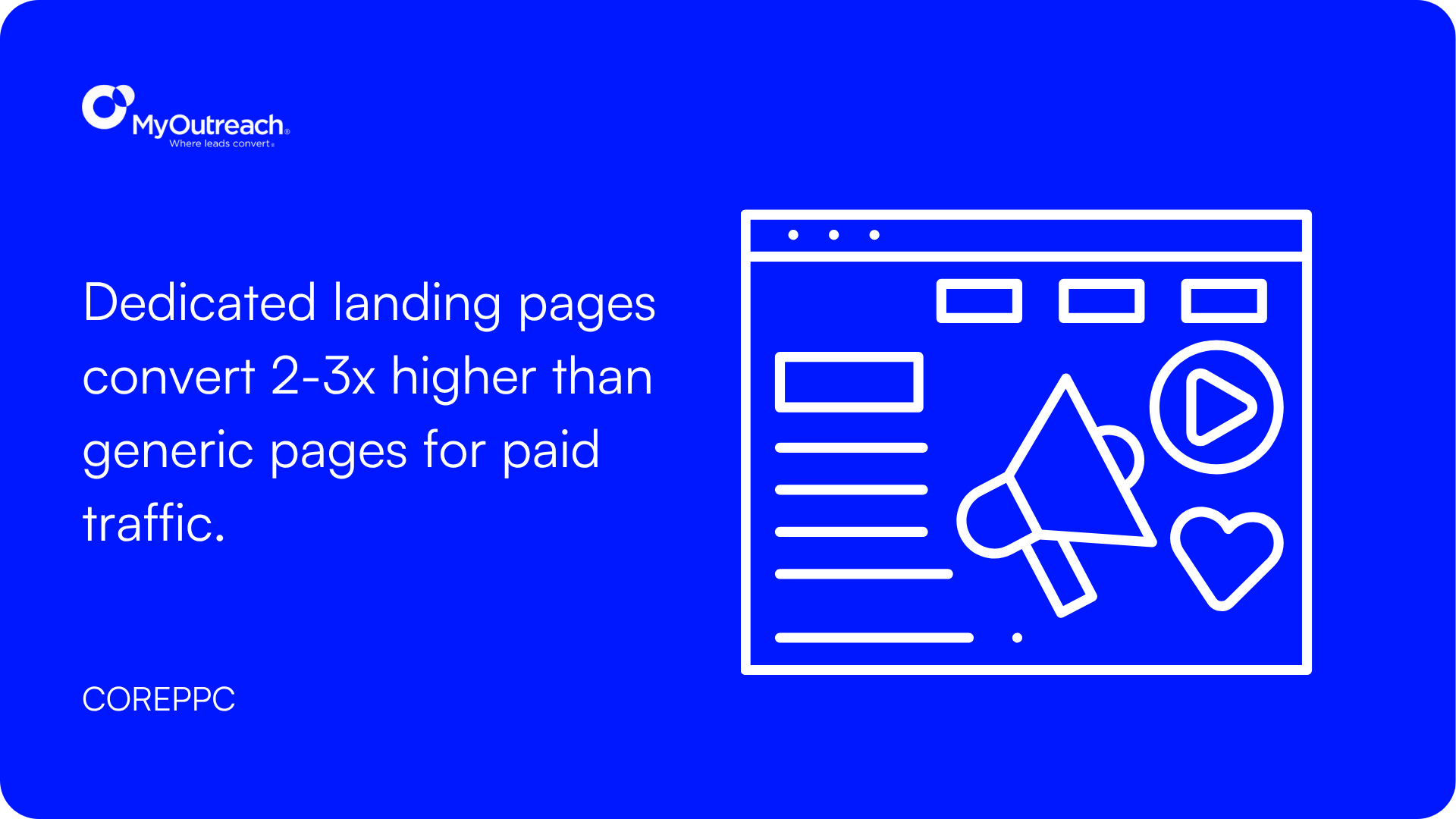
The page someone lands on after clicking a B2B programmatic ad needs to match the specific promise of the creative. Dedicated landing pages convert 2-3x higher than generic pages for paid traffic, so sending all programmatic traffic to your homepage, designed to orient a first-time visitor rather than convert someone who clicked through on a specific claim, is a common and costly mistake.
Conversion tracking
Make sure you can actually measure what happens after a click. This sounds obvious. In practice, a surprising number of B2B advertisers are running programmatic campaigns with incomplete tracking, which means the DSP is optimizing on bad data.
CRM integration
To measure pipeline influence over time, you need to connect account-level ad exposure data to your CRM records. Some DSPs support this natively. Others require additional work. Either way, build it before you spend serious budget, not after.
Frequently asked questions about B2B programmatic advertising
What is B2B programmatic advertising?
B2B programmatic advertising is the automated buying and placement of digital ads targeted at business buyers, using real-time bidding across ad exchanges.
Unlike B2C programmatic, which targets individual consumers at scale, B2B programmatic focuses on reaching specific decision-makers within target accounts, layering firmographic data, job title filters, and intent signals to reach the right people at the right companies.
How is B2B programmatic different from B2C programmatic?
The mechanics are the same: DSPs, real-time bidding, ad exchanges. The strategy is fundamentally different. B2B buying involves committees of 6 to 13 stakeholders, cycles of 10 to 18 months, and a research phase where 80% of the decision is made before a buyer ever contacts a vendor.
B2C optimizes for volume and click-through. B2B programmatic needs to optimize for account-level reach, brand recall among small, specific audiences, and pipeline influence that often takes months to show up in attribution.
What kind of targeting works in B2B programmatic?
The most effective B2B programmatic campaigns stack multiple targeting layers: firmographic filters (company size, industry, revenue, tech stack), role and seniority targeting, intent signals showing which accounts are actively researching your category, and account-based targeting against a specific Target Account List.
Using any single layer in isolation tends to produce broad, inefficient campaigns. Layering them together is where targeting gets precise.
What is intent data and why does it matter for B2B programmatic?
Intent data tracks the content consumption behaviour of companies and individuals across the web, signalling which accounts are actively researching specific topics. In the context of B2B programmatic advertising, it lets you prioritise spend on accounts that are actually in a buying motion rather than targeting by job title or industry alone.
How much should a B2B programmatic campaign cost?
There's no fixed answer because it depends on your ICP, the scale of your Target Account List, the markets you're running in, and what platforms and data layers you're using. CPMs for B2B-relevant inventory averaged around $5.82 in 2024, up significantly from prior years as the shift toward higher-quality placements pushed costs up.
The more useful question is cost-per-qualified-outcome, which requires proper tracking and a long enough window to measure pipeline influence. If you want a realistic budget range for your specific situation, the best starting point is a conversation with a demand generation team that runs these campaigns regularly.
The short version
B2B programmatic advertising works when it's built around the right foundations: a well-defined ICP, intent data layering, account-based targeting, creative that respects how long B2B buying actually takes, and measurement frameworks that don't demand last-touch credit from a channel that mostly operates above the click.
It fails when it's treated like B2C advertising with a higher minimum spend.
The gap between those two outcomes isn't mysterious. It's a question of whether you've set the channel up to do the job it's actually suited for.
If you want to run B2B programmatic tied to intent data and coordinated with your wider demand generation program, the MyOutreach team works on exactly that. Get in touch and we can talk through what a campaign built around your ICP and Target Account List would look like.
.jpg)


.webp)

.webp)
.webp)